I have been making my way through a lot of long book series over the last few years, and once you fall into the right one, the books disappear faster than you expect. Joe Ledger is the one I am deep into right now, and that reminded me how many great multi-book runs I have already finished.
This list covers 11 major sci-fi and thriller series, totaling about 60 books, which works out to roughly 600–800 hours of reading or listening depending on your audiobook speed. They range from military thrillers to alien epics to virtual worlds, and a few changed how I think about technology, AI, or the future.
If you choose just one to start, I still recommend Project Hail Mary by Andy Weir, the same author behind The Martian (Matt Damon). Soon to be a blockbuster movie with Ryan Gossling (trailer video).
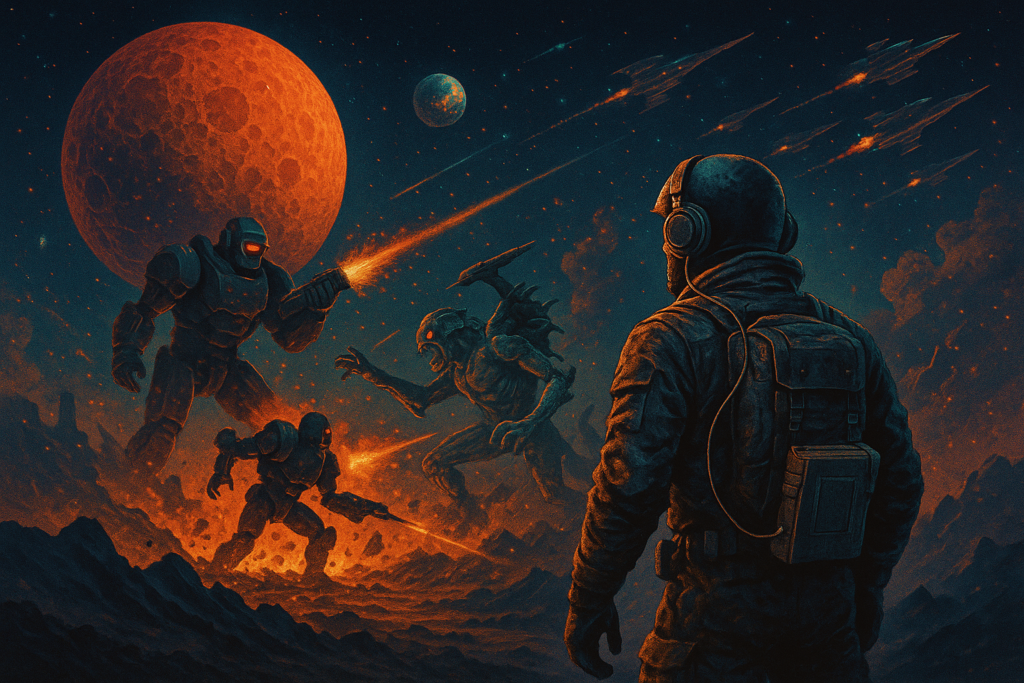
Here are the series that made the strongest impression on me.
Joe Ledger Series — Jonathan Maberry
Books: 12 main novels (2009–2022)
Narrator: Ray Porter
Key title: Patient Zero (2009)
Other noteworthy works: Rot & Ruin (YA zombie series)
Joe Ledger is a Baltimore cop pulled into a secret government task force that handles threats so extreme they barely sound possible. Designer plagues. Genetic weapons. Transhuman experiments. Rogue scientists building the kinds of organisms we hope never escape the lab. Every book focuses on a different biotechnological threat, and Ledger balances intensity, dry humor, and humanity in a way that makes you stick with him through the entire run. This series mixes sci-fi with military thriller pacing better than almost anything I have read.
The Gray Man Series — Mark Greaney
Books: 13+ (2009–present)
Narrator: Jay Snyder
Key title: The Gray Man (2009)
Other noteworthy works: Tom Clancy’s Jack Ryan novels (co-author)
Court Gentry is a former CIA assassin trying to stay alive in a world where everyone is hunting him. The series is sharp, tactical, and consistently grounded in believable tradecraft and geopolitics. The Netflix movie was fun, but the books show a far more complex version of Court. If you enjoy The Bourne Identity or The Terminal List, Greaney belongs right beside them. It is not sci-fi, but it gives you the same adrenaline rush that keeps pulling you into the next book.
The Three-Body Problem Trilogy — Liu Cixin
Books: The Three-Body Problem (2008), The Dark Forest (2008), Death’s End (2010)
Narrators: Luke Daniels and others
Key title: The Three-Body Problem
Other noteworthy works: Ball Lightning, The Wandering Earth
This trilogy is mind-bending in the best possible way. It starts as a slow mystery about strange signals and broken physics, then expands into one of the most ambitious visions of humanity’s future ever written. The Dark Forest delivers the most convincing argument for fearing alien contact that I have ever encountered. The Netflix series is excellent, and it was the first time in years that a show captured the same “Black Mirror” energy in a science fiction setting. If you want sci-fi that changes how you think about civilization, time, and survival, this is it.
Ready Player One Series — Ernest Cline
Books: Ready Player One (2011), Ready Player Two (2020)
Narrator: Wil Wheaton
Key title: Ready Player One
Other noteworthy works: Armada (similar VR and gaming themes)
These are two of the most purely enjoyable audiobooks ever recorded. Wil Wheaton brings the virtual world of the OASIS to life in a way that almost feels like a performance rather than narration. The stories mix gaming culture, 80s nostalgia, VR futurism, and good old-fashioned adventure. The movie is fun, but the book is uniquely great, and the sequel builds on the world in unexpected ways. If you grew up with video games, even a little, this series scratches a very specific itch.
Daemon & Freedom — Daniel Suarez
Books: Daemon (2006), Freedom (2010)
Narrator: Jeff Gurner
Key title: Daemon
Other noteworthy works: Influx, Change Agent, Kill Decision
This is Ready Player One on steroids, except grounded in real computer architecture and weaponized AI. A brilliant game developer dies and leaves behind an autonomous AI that activates a series of steps intended to reshape society. The technology feels alarmingly plausible, especially the automated weapon systems and crowdsourced enforcement tools. These books were ahead of their time, and if you work in tech or security, they hit even harder.
The Ender Saga (Selected) — Orson Scott Card
Books: Ender’s Game (1985), Ender’s Shadow (1999)
Narrators: Stefan Rudnicki, Harlan Ellison, others
Key title: Ender’s Game
Other noteworthy works: Speaker for the Dead, Xenocide
Ender’s Game remains one of the strongest coming-of-age sci-fi stories ever written, mixing zero-gravity battle school mechanics with moral and strategic dilemmas that stay with you long after it ends. Ender’s Shadow retells the story from Bean’s perspective and works better than most sequels. The later books branch off into deeper philosophical territory, but the first two are essential.
Anne Rice’s Vampire Chronicles — Anne Rice
Books read: Interview with the Vampire (1976), The Queen of the Damned (1988), Memnoch the Devil (1995)
Narrators: Simon Vance and others
Key title: Interview with the Vampire
Other noteworthy works: The Witching Hour, Cry to Heaven, The Mummy
This was the first major series I ever fell into as a teenager. Most people know Interview with the Vampire because of the Tom Cruise and Brad Pitt movie, but the book is richer, stranger, and more introspective. The entire universe revolves around Lestat, even though the first book is narrated by Louis. Rice later expanded the mythology with the Witching Hour trilogy and unrelated novels like Cry to Heaven and The Mummy, both of which are excellent in completely different ways.
Red Rising Saga — Pierce Brown
Books: 5 core books (2014–2021)
Narrator: Tim Gerard Reynolds
Key title: Red Rising
Other noteworthy works: Light Bringer, Iron Gold
These books are long, dense, and packed with world-building. Modern publishers might have split each one into two or three separate releases. The series follows Darrow, a miner from Mars who infiltrates the ruling class to bring down the oppressive hierarchy from within. It starts as a class-war revolution and grows into a galaxy-spanning epic. Once it grabs you, it does not let go.
We Are Legion (We Are Bob) — Dennis E. Taylor
Books: 3 books (2016–2017)
Narrator: Ray Porter
Key title: We Are Legion (We Are Bob)
Other noteworthy works: Outland, Roadkill
This is one of the funniest and most creatively structured sci-fi series I have listened to. Bob dies, wakes up as an uploaded consciousness, and becomes the AI of a self-replicating spaceship. Every new ship spawns another version of Bob with its own quirks. The series balances humor, exploration, and existential questions without ever slowing down. Ray Porter’s narration elevates it even further.
The Expanse — James S. A. Corey
Books read: Leviathan Wakes (2011)
Narrator: Jefferson Mays
Key title: Leviathan Wakes
Other noteworthy works: Caliban’s War, Abaddon’s Gate
This is some of the best modern space opera ever written. The political tension between Earth, Mars, and the Belt feels grounded, and the alien protomolecule gives the story a constant sense of scale and danger. The TV adaptation is one of the strongest sci-fi shows made in the last decade. If you like realistic space travel mixed with big-idea sci-fi, this is essential reading.
Metro Trilogy — Dmitry Glukhovsky
Books: Metro 2033 (2005), Metro 2034 (2009), Metro 2035 (2015)
Narrator: Rupert Degas
Key title: Metro 2033
Other noteworthy works: Metro 2035 game tie-ins
This is one of the bleakest, most atmospheric post-apocalyptic series I have ever read. Survivors of nuclear war live in the Moscow metro system, where every station has its own culture, dangers, and mysteries. The books made replaying the Metro video games even better, especially the VR adaptation. If you want claustrophobic, survival-driven sci-fi, this is a standout trilogy.
Titans & Deadmen’s War — Anthony J. Melchiorri
Books:
Titans: Titans (2016), Cataclysm (2016), Conquest (2017)
Deadmen’s War: Deadmen’s War (2021), Deadmen’s Empire (2021), Deadmen’s Resurrection (2022)
Narrator: Ryan Turner
Key titles: Titans, Deadmen’s War
Other noteworthy works: The Tide series
Melchiorri has two biotech-driven military sci-fi series worth mentioning together. Titans follows genetically and biomechanically enhanced soldiers built to survive radiation, toxins, alien terrain, and close-quarters combat that would kill a normal human instantly. It feels grounded and tactical, with a focus on the ethics and costs of turning people into engineered weapons. Deadmen’s War goes in a very different direction. Here, soldiers pilot massive living alien war-beasts through biological interfaces, creating battles that feel like a biological version of Pacific Rim. The creatures are powerful, unpredictable, and terrifying, and the bond between human and organism gives the series a unique edge.
Narrator Spotlight
Ray Porter – Joe Ledger, We Are Legion (We Are Bob), The Way of Kings (partial cast)
Wil Wheaton – Ready Player One, Ready Player Two, Armada, John Scalzi’s Lock In, FreakAngels, various short fiction collections
Jay Snyder – The Gray Man, select editions of The Terminal List
Jeff Gurner – Daemon, Freedom, Kill Decision
Jefferson Mays – The Expanse, Project Hail Mary (special edition), Bioshock: Rapture
Stefan Rudnicki – Ender’s Game, Speaker for the Dead, Xenocide
Rupert Degas – Metro 2033, Metro 2035, multiple genre and YA titles
R.C. Bray – The Martian, Expeditionary Force, Hell Divers, Rhino, Bunker, and many top post-apocalyptic and military sci-fi series