My oldest child is a game design major. The program is very anti-AI. That reaction is understandable when you are trying to learn the fundamentals of a craft. Nobody wants shortcuts replacing real skill while they are still trying to master the basics.
One thing that surprised me is how many students in the program are not actually programmers. Many are designers, artists, planners, or storytellers. That makes sense for game development, which is naturally multidisciplinary, but it also creates an interesting dynamic when technology begins to lower barriers.
My son is one of the true coders in the program. He can actually build things from scratch.
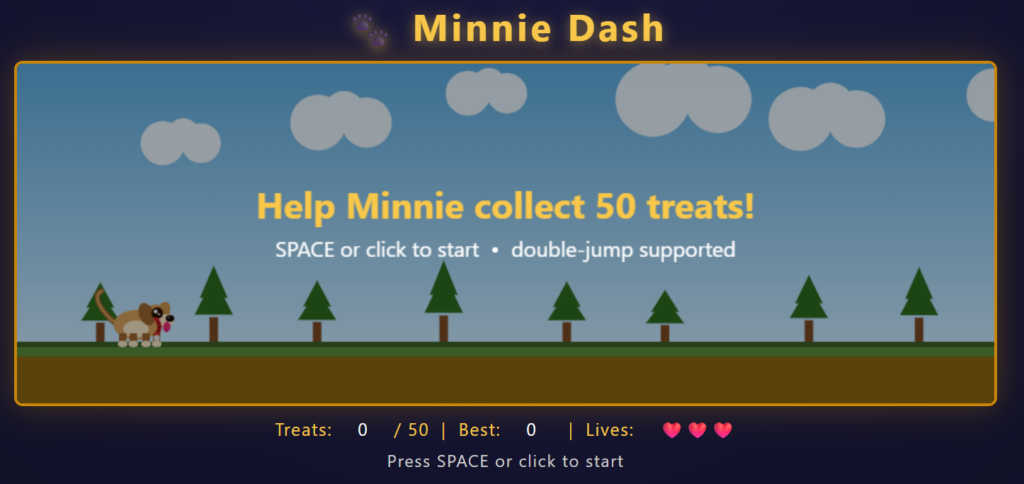
Recently I decided to make a small point. I created a simple browser game called Minnie Dash. The first working version was produced by Claude in under ten minutes. I provided a prompt, followed up with a few adjustments to shape the gameplay a bit, and that was essentially it.
The result is simple, but it is a playable game.
Repository:
https://github.com/AndrewBlumhardt/minnie-dash
Playable version:
https://andrewblumhardt.github.io/minnie-dash/
This experiment was not meant to prove that AI can replace developers. The code is rough, the mechanics are basic, and the game is far from polished. But it does highlight something important about where things may be headed.
Vibe coding is almost certainly going to change the face of game development.
Students who previously had little or no coding ability can now generate functional code very quickly. That allows them to focus on the areas where they already excel, such as storytelling, visual design, level concepts, and overall game mechanics. Instead of waiting for a programmer to prototype an idea, they can now experiment on their own.
At the same time, someone who already understands programming has a different kind of advantage. They can guide the AI more effectively, recognize when the generated code is wrong, restructure it, and improve it. They can also extend the game beyond what a quick prompt produces.
In a word, the balance may be shifting.
In the past, students without coding skills might have felt like imposters in a technical environment. Coders, on the other hand, often carried a certain level of status because they controlled the hardest part of building a game. Vibe coding may begin to flatten that distinction. Designers and artists can now generate working code, while programmers can move faster than ever by building on AI output.
That does not necessarily mean developers disappear, although the role will likely change dramatically. It does suggest that the next generation of game creators will need to be more balanced across disciplines. A strong programmer will still benefit from good design instincts, while a talented designer will increasingly need to understand how to guide and shape AI-generated systems.
For now, Minnie Dash is just a tiny experiment. I may return to it later to refine the mechanics, improve the visuals, or add more gameplay elements. But even this small test made the point I wanted to illustrate.
Game development may be entering a phase where the lines between coder, designer, and creator become much less rigid, with a little AI helping everyone move faster.