Like many people, I’ve gotten into the habit of simply choosing the newest model and moving on. GPT-5? Sure. Claude Opus? Sounds good. Gemini 2.5 Pro? Why not? Beyond a general understanding that some models are better at coding, some reason more deeply, and some are optimized for speed or lower cost, I realized I didn’t really understand the growing collection of AI companies, models, and platforms I was using every day.
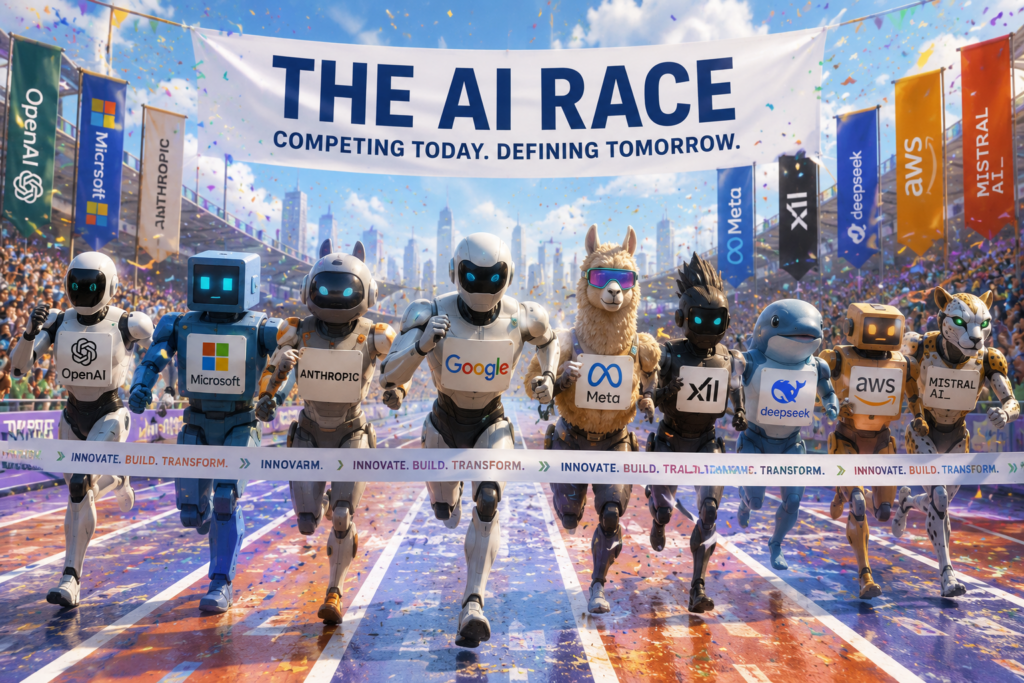
For developers building AI-powered applications, model selection is a careful balance of capability, cost, latency, privacy, hosting platform, and licensing. Most of us, however, don’t make those decisions very often. Whether we’re using ChatGPT, Claude, Gemini, GitHub Copilot, or Microsoft Copilot, the platform usually recommends a model or limits our choices. Even platforms like Azure AI Foundry often make it easy to simply choose the newest model and move on. I realized I had fallen into that habit myself.
As I started digging deeper, I discovered this wasn’t simply a story about language models. It was a story about an industry evolving at an extraordinary pace. Throughout this article, we’ll explore roughly ten of the companies leading the development of frontier AI models, but building the model is only one part of today’s AI ecosystem. Several of these organizations have expanded into enterprise AI services, delivering secure, managed AI capabilities through software-as-a-service offerings. Others provide AI cloud platforms, allowing organizations to build, host, and operate their own AI applications and agents using one or many frontier models within their own cloud environments.
These categories are not mutually exclusive. Companies like Microsoft and Google participate in all three. OpenAI and Anthropic have paired frontier models with enterprise AI services, while Amazon combines its own foundation models with one of the industry’s largest AI cloud platforms. Databricks, although not known primarily for frontier models, has become an important enterprise AI platform by helping organizations build AI solutions around their own data. Understanding these distinctions helped me better appreciate not only the companies themselves, but also how the AI industry has evolved.
This article takes a closer look at many of the organizations shaping the modern AI industry, including OpenAI, Microsoft, Anthropic, Google, Meta, xAI, DeepSeek, Amazon, and Mistral AI. We’ll also briefly revisit IBM, whose work with Watson helped introduce AI to a broad public audience, along with companies and platforms such as NVIDIA, Databricks, and OpenClaw that are influencing the infrastructure and orchestration layers surrounding today’s models.
If you’ve ever found yourself choosing a model simply because it happened to be the default, you’re probably not alone. My hope is that by the end of this article, we’ll both have a much clearer understanding of not only today’s AI models, but the rapidly evolving ecosystem surrounding them.
A note about this article: This article reflects my own research, professional experience, and opinions on the rapidly evolving AI landscape. Given the pace of innovation, I also used the latest GPT models to assist with research, fact-checking, organization, and editing. Every effort has been made to validate factual statements using publicly available information, though this industry continues to evolve at an extraordinary pace.
The OpenAI Model Family
OpenAI changed the AI industry almost overnight. While large language models had existed for years, the public release of ChatGPT in late 2022 transformed generative AI from an emerging technology into a mainstream tool used by millions of people. For many people, ChatGPT was their first meaningful interaction with artificial intelligence, and it quickly became the benchmark against which every other AI assistant would be measured.
The GPT family has evolved rapidly since then. GPT-3.5 introduced conversational AI at global scale. GPT-4 significantly improved reasoning, coding, reliability, and enterprise adoption. GPT-5 expanded multimodal capabilities, stronger reasoning, and agentic workflows. More recent releases have continued refining these capabilities through improvements in coding, cybersecurity, scientific applications, efficiency, and specialized reasoning. As these models have advanced, OpenAI has increasingly become viewed not simply as a chatbot company, but as one of the world’s leading frontier AI research organizations.
Beyond language models, OpenAI also helped define public expectations for generative AI. DALL·E brought AI image generation to a mainstream audience, while Sora demonstrated how rapidly AI-generated video was advancing. Whether or not these were the first systems of their kind, they became defining moments in the public perception of what generative AI could create.
Specialized models have become another defining trend. Codex was one of OpenAI’s earliest major efforts to build models specifically for software engineering, laying the foundation for today’s coding agents capable of generating, reviewing, debugging, documenting, and testing software. OpenAI has also introduced models optimized for areas such as healthcare, scientific research, and cybersecurity, reflecting a broader industry trend toward domain-specific AI rather than relying on a single model for every task.
At the same time, OpenAI expanded beyond a consumer chatbot into enterprise AI services. Offerings such as ChatGPT Team and ChatGPT Enterprise provide organizations with administrative controls, collaboration features, enterprise privacy commitments, connectors to business systems, and higher usage limits. Rather than simply providing access to a language model, these services allow organizations to adopt generative AI within a managed environment designed for business use. As we’ll see throughout this article, Microsoft, Google, and Anthropic have each taken similar approaches, making enterprise AI services one of the fastest-growing segments of the industry.
The Microsoft partnership became another defining chapter in OpenAI’s evolution. Microsoft’s early investment in OpenAI, combined with Azure’s role as OpenAI’s primary cloud infrastructure provider, fundamentally changed the trajectory of both companies. The partnership accelerated OpenAI’s ability to train increasingly capable frontier models while giving Microsoft an early leadership position in bringing generative AI into enterprise products and cloud services. That relationship also laid the foundation for Azure OpenAI Service, Azure AI Foundry, Microsoft 365 Copilot, and many of the enterprise AI capabilities we’ll discuss in the next section.
Today, OpenAI remains one of the industry’s defining companies. While competitors have emerged with their own philosophies and areas of specialization, ChatGPT marked the moment generative AI entered the mainstream. Nearly every company discussed throughout the remainder of this article has, in one way or another, built upon, differentiated from, or responded to that breakthrough.
The following timeline highlights the major milestones in OpenAI’s evolution, illustrating how the company expanded from conversational AI into multimodal models, specialized domain expertise, enterprise services, and one of the world’s leading frontier AI research organizations.
| Model / Service | Availability | Primary Purpose | Max Context Window* | Notes |
| GPT-3 | 2020–2022 | General-purpose language model | ~2K–4K | First widely adopted GPT model. |
| GPT-3.5 | 2022–2024 | Conversational AI | ~4K–16K | Powered the original public ChatGPT experience. |
| GPT-4 | 2023–2025 | Advanced reasoning | Up to 128K | Major leap in reasoning and enterprise adoption. |
| GPT-4.5 | 2025–2026 | Premium general-purpose LLM | 128K | Known for exceptionally natural writing and conversation. |
| GPT-4 Turbo | 2023–2025 | Lower-cost GPT-4 | 128K | Faster and less expensive than GPT-4. |
| GPT-4o | 2024–Present | Multimodal AI | 128K | Unified text, vision, and voice capabilities. |
| GPT-5 | 2025–2026 | Flagship foundation model | Varies | Introduced stronger reasoning, multimodal capabilities, and agentic workflows. |
| GPT-5.5 | 2026 | Enhanced GPT-5 | Varies | Incremental improvements in capability and efficiency. |
| GPT-5.6 | 2026–Present | Current flagship | Varies | Current state-of-the-art GPT model. |
| GPT Mini family | 2025–Present | Cost-optimized models | Varies | Lower-cost models designed for high-volume workloads. |
| o-series | 2024–Present | Advanced reasoning | Varies | Optimized for complex reasoning and analysis. |
| Codex | 2021–Present | Software engineering | Varies | Foundation for OpenAI’s coding models and autonomous coding agents. |
| Security-focused models | 2026–Present | Secure software development | Varies | Specialized models for software security and vulnerability research. |
| gpt-oss-120B | 2026–Present | Open-weight research | Varies | Designed for self-hosting, experimentation, and fine-tuning. |
| DALL·E | 2021–Present | Image generation | N/A | Helped popularize high-quality text-to-image generation. |
| Sora | 2024–2026 | Video generation | N/A | Early large-scale text-to-video platform. |
| Whisper | 2022–Present | Speech recognition | N/A | Speech-to-text and transcription model. |
| Deep Research | 2025–Present | Research agent | Varies | Multi-step autonomous research and analysis. |
| ChatGPT Agent & Connectors | 2025–Present | Agentic workflows | Varies | Integrates with external applications, enterprise services, and user-approved data sources. |
Microsoft
If OpenAI introduced generative AI to the world, Microsoft demonstrated how it could be adopted by the enterprise. Although Microsoft had invested in artificial intelligence for decades through Azure Machine Learning, Cognitive Services, and other Azure AI offerings, the public release of ChatGPT placed the company in a unique position. Its early investment in OpenAI and long-standing Azure partnership meant Microsoft was able to move from AI research to enterprise adoption faster than almost anyone else.
Within months of ChatGPT’s release, Microsoft introduced Microsoft 365 Copilot, becoming the first company to bring generative AI to the enterprise at global scale. Copilot allowed organizations to use AI securely within the Microsoft 365 ecosystem they already trusted. Employees could summarize meetings, draft emails, analyze spreadsheets, search internal documents, create presentations, and interact with company knowledge while respecting existing permissions, identity, compliance, and data protection policies. For many organizations, this became their first practical deployment of generative AI in the workplace.
Microsoft quickly demonstrated that the same approach could extend beyond productivity. Security Copilot became one of the first enterprise AI services designed specifically for cybersecurity operations, helping analysts investigate incidents, summarize alerts, generate hunting queries, analyze malware, and accelerate incident response. Microsoft has continued investing heavily in AI-driven security through its public collaboration in evaluating Claude Mythos, early announcements around MDASH for AI-assisted vulnerability discovery and secure code analysis, and a growing portfolio of AI capabilities designed specifically for security operations and secure software development.
Microsoft made an equally significant investment in software engineering through GitHub Copilot. Integrated into Visual Studio Code, Visual Studio, JetBrains IDEs, GitHub, and the command line, GitHub Copilot helps developers generate code, explain unfamiliar code, create documentation, troubleshoot problems, and generate tests. As the platform has matured, Microsoft’s vision has expanded beyond code completion toward agentic software engineering, where AI increasingly acts as a collaborative development partner rather than simply an autocomplete engine.
Microsoft’s broader vision has now expanded into the emerging era of autonomous AI agents. Services such as Teams Agent Builder, Copilot Studio, Agent 365, and Microsoft Entra Agent ID allow organizations to build, secure, and manage AI agents that can interact with enterprise data and automate business processes. Microsoft has also embraced this next generation of AI through support for CoWork, early announcements of Scout for autonomous software engineering, and demonstrations of OpenClaw running on Windows at Microsoft Build 2026. Together, these investments illustrate Microsoft’s belief that the future of AI lies not only in more capable models, but in intelligent agents, orchestration frameworks, and AI harnesses capable of coordinating work across multiple models and tools.
At the same time, Microsoft continues to invest heavily in the infrastructure that powers enterprise AI. Azure AI Foundry builds upon Microsoft’s long history of Azure AI services by providing a unified platform for developing, evaluating, and deploying AI applications using models from OpenAI, Anthropic, Meta, Mistral, DeepSeek, xAI, Microsoft’s own MAI models, and many others. For several years, Microsoft Azure served as OpenAI’s exclusive cloud infrastructure provider, supplying the enormous compute capacity required to train and operate OpenAI’s frontier models while also becoming the only major cloud platform through which enterprises could privately access the latest OpenAI models within their own Azure environments. Although OpenAI has since expanded to additional infrastructure partners, Azure remains one of the industry’s leading enterprise AI platforms and a cornerstone of Microsoft’s AI strategy.
For much of the generative AI era, Microsoft focused on bringing frontier models to the enterprise rather than building its own. That began to change at Microsoft Build 2026, when the company introduced the MAI family of foundation models, signaling Microsoft’s intention to compete not only as an enterprise AI platform provider, but also as a frontier AI model developer while continuing to embrace a broad multi-model ecosystem.
Today, Microsoft occupies a unique position within the AI landscape. It is simultaneously a frontier AI developer, an enterprise AI service provider, and one of the world’s leading AI cloud platforms. More than any other company, Microsoft has focused on transforming generative AI from an impressive technology demonstration into secure, governed, enterprise-scale business solutions.
| Product / Model | Availability | Category | Primary Models | Notes |
| Azure AI Services | 2015–Present | AI Platform | Microsoft AI | Cognitive Services, speech, vision, translation, and machine learning services that predate the LLM era. |
| Azure Machine Learning | 2018–Present | AI Platform | Customer models | Platform for building, training, and deploying custom AI and machine learning models. |
| GitHub Copilot | 2022–Present | AI-assisted Development | OpenAI, Claude, MAI | One of the first mainstream AI coding assistants. |
| Azure OpenAI Service | 2023–2025 | Enterprise LLM Platform | OpenAI GPT family | Brought OpenAI models to Azure with enterprise security and governance. |
| Microsoft 365 Copilot | 2023–Present | Enterprise Productivity | OpenAI, MAI | AI integrated into Word, Excel, Outlook, Teams, PowerPoint, and more. |
| Copilot Studio | 2023–Present | Agent Development | Multiple | Build custom copilots and enterprise AI agents. |
| Security Copilot | 2024–Present | Cybersecurity | OpenAI, MAI | AI assistant for security operations and incident response. |
| Phi Family | 2024–Present | Small Language Models | Microsoft | Microsoft’s family of efficient SLMs for local and edge AI. |
| Azure AI Foundry | 2025–Present | Enterprise AI Platform | OpenAI, Anthropic, Meta, DeepSeek, xAI, Mistral, MAI, Phi | Unified platform for models, agents, evaluation, and governance. |
| Dragon Copilot | 2025–Present | Healthcare | Microsoft | Clinical documentation and healthcare workflows. |
| MAI Family | 2026–Present | Frontier Models | Microsoft | Microsoft’s first family of frontier multimodal foundation models. |
| Scout | 2026–Present | AI Software Engineering | OpenClaw + Microsoft | Autonomous software engineering agent. |
Anthropic
Founded in 2021 by former OpenAI researchers, including siblings Dario and Daniela Amodei, Anthropic emerged as one of OpenAI’s strongest competitors with a distinct emphasis on AI safety. The company was built around the belief that increasingly capable AI systems should also become more reliable, predictable, and aligned with human values.
That philosophy became known as Constitutional AI. Rather than relying solely on human feedback, Anthropic developed methods that encourage models to evaluate their responses against a defined set of principles. This helped establish Claude’s reputation for thoughtful responses, strong reasoning, and careful handling of complex requests. More broadly, Anthropic has positioned itself as a company willing to prioritize responsible AI development, even when those decisions create political or commercial challenges.
Anthropic organizes its core Claude models into recognizable tiers. Haiku emphasizes speed and efficiency, Sonnet balances capability and cost, and Opus represents the company’s most capable general-purpose model family. Newer releases such as Fable extend that progression into longer-running, highly agentic work, while Mythos applies frontier capabilities to sensitive domains including cybersecurity, biology, and healthcare. Mythos remains available only to carefully vetted organizations because of the potential risks associated with its capabilities.
Software engineering has become one of Anthropic’s defining strengths. Claude Code allows developers to explore codebases, edit files, run commands, write tests, fix bugs, and complete larger engineering tasks directly from the terminal or development environment. Claude Cowork extends similar agentic capabilities beyond coding, allowing knowledge workers to delegate multi-step work involving documents, applications, browsers, and local files. Claude Tag adds collaborative capabilities that enable teams to organize and share AI-assisted work more effectively.
Another hallmark of Claude has been practical long-context reasoning. Anthropic was among the first companies to make it practical to analyze extensive documentation, large source code repositories, contracts, and research material within a single interaction. Current Claude models support context windows reaching one million tokens, although the practical value still depends on how effectively the model reasons across that information rather than simply accepting larger inputs.
Like OpenAI, Anthropic keeps its frontier models closed rather than releasing their weights publicly. Organizations can consume Claude through Claude Enterprise, which provides enterprise administration, collaboration, privacy commitments, and security controls, or through managed AI cloud platforms including Amazon Bedrock, Google Vertex AI, and Azure AI Foundry. This reflects Anthropic’s strategy of combining enterprise AI services with broad availability across leading cloud platforms.
Anthropic’s commitment to its stated principles became especially visible during its 2026 dispute with the U.S. government. The company publicly resisted certain uses of Claude involving fully autonomous weapons and mass domestic surveillance, leading to temporary restrictions affecting government adoption and additional controls around models such as Fable and Mythos. Regardless of one’s perspective on that dispute, Anthropic demonstrated a willingness to accept real business consequences rather than quietly abandoning its publicly stated position on responsible AI development.
Today, Anthropic has established a distinct identity around coding, agentic work, long-context reasoning, specialized frontier models, and principled AI development. Claude Code, Cowork, Tag, Fable, and Mythos illustrate a company that has expanded well beyond conversational AI into software engineering, knowledge work, cybersecurity, healthcare, and scientific research.
The following timeline highlights Anthropic’s evolution from its original Claude models to today’s specialized reasoning, coding, agentic, and high-assurance AI systems.
| Model / Service | Availability | Primary Purpose | Max Context Window* | Notes |
| Claude 1 | 2023–2023 | General-purpose LLM | ~100K | Anthropic’s first commercial Claude model. |
| Claude 2 | 2023–2024 | Conversational AI | 100K | Major improvements in reasoning and context size. |
| Claude 2.1 | 2023–2024 | Enhanced Claude 2 | 200K | Reduced hallucinations and doubled the context window. |
| Claude 3 Haiku | 2024–Present | Fast, low-cost model | 200K | Optimized for speed and high-volume workloads. |
| Claude 3 Sonnet | 2024–2025 | General-purpose model | 200K | Strong balance of capability, speed, and cost. |
| Claude 3 Opus | 2024–2025 | Frontier reasoning model | 200K | Anthropic’s flagship model prior to Claude 4. |
| Claude 3.5 Sonnet | 2024–2025 | Enhanced coding & reasoning | 200K | Widely regarded as one of the industry’s strongest coding models. |
| Claude 3.7 Sonnet | 2025–2026 | Hybrid reasoning model | 200K | Introduced extended thinking for more complex reasoning tasks. |
| Claude 4 Sonnet | 2025–Present | General-purpose frontier model | 200K | Current workhorse model for enterprise and software engineering. |
| Claude 4 Opus | 2025–Present | Highest-capability frontier model | 200K | Anthropic’s most capable publicly available Claude model. |
| Claude Fable | 2026–Present | Next-generation flagship | 500K+ | Anthropic’s newest flagship foundation model. |
| Claude Mythos | 2026–Present | Cybersecurity & scientific research | 500K+ | Specialized model for cybersecurity, biology, healthcare, and other high-assurance domains. Limited availability. |
| Claude Code | 2025–Present | AI software engineering | Model-dependent | Integrates directly into developer workflows for coding, debugging, testing, and documentation. |
| Claude Code CoWork | 2026–Present | Agentic software engineering | Model-dependent | More autonomous software development across larger engineering tasks. |
| Claude.ai | 2023–Present | Consumer & enterprise chat platform | Model-dependent | Anthropic’s primary user interface for Claude models. |
| Anthropic API | 2023–Present | Enterprise & developer platform | Model-dependent | API access to Claude models for custom applications and integrations. |
Google’s place in the modern AI landscape is one of the more interesting stories in the industry. For decades, the company has been recognized as one of the world’s leading AI research organizations. Through Google Brain, DeepMind, TensorFlow, AlphaGo, AlphaFold, custom Tensor Processing Units (TPUs), and perhaps most importantly, the Transformer architecture introduced in the landmark paper Attention Is All You Need, Google helped establish much of the technical foundation upon which today’s large language models are built.
Yet despite that remarkable research pedigree, it wasn’t Google that introduced generative AI to the mainstream. OpenAI captured the public’s attention with ChatGPT, Microsoft quickly transformed those capabilities into enterprise products through Copilot, and Anthropic established itself as a leader in software engineering and responsible AI. For a company with Google’s history in artificial intelligence, that outcome surprised many observers.
Looking back, it’s difficult not to wonder why. Part of the answer may simply be that Google was a much larger, more established company. Organizations of that scale often move more deliberately, particularly when introducing technologies capable of disrupting their own business. Google also had more to lose than almost anyone else. For years, Search had been one of the most successful products in technology, and generative AI represented one of the first credible alternatives to the traditional search experience. Whether that influenced Google’s pace is something only the company can answer, but it remains an interesting chapter in the history of generative AI.
Once Google fully committed to the generative AI era, however, it moved quickly. Gemini became the company’s flagship family of foundation models, with Flash models optimized for speed and efficiency, Pro models balancing capability and cost, and increasingly capable frontier models focused on reasoning, multimodal understanding, and agentic AI. Unlike many earlier language models that evolved into multimodal systems over time, Gemini was designed from the outset as a multimodal architecture capable of understanding text, images, audio, video, and code within a unified model.
Google’s strategy extends well beyond Gemini itself. Vertex AI has become Google’s enterprise AI platform, allowing organizations to build, deploy, evaluate, and govern AI applications on Google Cloud Platform (GCP). Like Microsoft Azure AI Foundry and Amazon Bedrock, Vertex AI provides access to Google’s own models while supporting an expanding catalog of third-party foundation models, giving customers flexibility without sacrificing enterprise governance and security.
Like Meta and xAI, Google also benefits from operating products used by billions of people every day. Search, YouTube, Gmail, Android, Chrome, Maps, and Workspace collectively represent one of the world’s largest information ecosystems. While Google does not publicly disclose the specific data used to train its frontier models, operating services at this scale provides significant opportunities to improve search, multimodal understanding, retrieval, and AI-powered user experiences.
Unlike Microsoft and Amazon, whose cloud platforms also provide core infrastructure for several leading frontier AI developers, Google has largely focused on advancing its own vertically integrated ecosystem spanning research, custom TPU hardware, Gemini models, and Vertex AI.
Google has also woven Gemini throughout its product portfolio. Gemini for Google Workspace brings AI into Gmail, Docs, Sheets, Slides, and Meet, competing directly with Microsoft 365 Copilot. AI capabilities now extend into Search, Chrome, Android, and many other Google products, reflecting the company’s long-standing strategy of embedding intelligence into the services people already use every day.
Beyond productivity, Google continues to invest heavily in multimodal AI and scientific research. Imagen has become one of the industry’s leading image generation models, Veo has established Google as a leader in AI-generated video, NotebookLM introduced an innovative approach to grounded research using a user’s own documents, and Gemma provides an open-weight family of models for developers and researchers. Together, these services demonstrate that Google’s AI strategy extends well beyond conversational AI, spanning consumer experiences, enterprise platforms, scientific discovery, and open model development.
Today, Google occupies a unique position within the AI landscape. It may not have been the company that popularized generative AI, but few organizations have contributed more to the underlying science that powers today’s frontier models. Google’s influence extends far beyond Gemini into the research breakthroughs, infrastructure, cloud services, and multimodal technologies that continue to shape the future of artificial intelligence.
The following timeline highlights Google’s evolution from foundational AI research to today’s multimodal models, enterprise AI platform, and broad ecosystem of consumer and developer AI services.
| Model / Service | Availability | Primary Purpose | Max Context Window* | Notes |
| LaMDA | 2021–2024 | Conversational language model | ~137B parameters | Google’s first widely publicized conversational LLM. |
| PaLM | 2022–2023 | General-purpose LLM | 8K | Successor to LaMDA and foundation for later models. |
| PaLM 2 | 2023–2024 | Enhanced language model | 32K | Improved multilingual, reasoning, and coding capabilities. |
| Gemini Nano | 2023–Present | On-device AI | Device-dependent | Optimized for Android and edge devices. |
| Gemini Flash | 2024–Present | Fast, cost-efficient LLM | Up to 1M tokens | Designed for low latency and high-volume workloads. |
| Gemini Pro | 2024–Present | General-purpose LLM | Up to 2M tokens | Google’s primary enterprise model family. |
| Gemini Ultra | 2024–Present | Frontier reasoning | Up to 2M tokens | Highest-capability Gemini model. |
| Gemini 2.x | 2025–Present | Multimodal frontier AI | Up to 2M+ tokens | Current flagship family emphasizing reasoning, multimodal AI, and agentic capabilities. |
| Gemma | 2024–Present | Open-weight models | Up to 128K | Google’s open-weight model family for developers and researchers. |
| Gemini Code Assist | 2024–Present | AI software development | Model-dependent | Coding assistant integrated with IDEs and Google Cloud. |
| Jules | 2025–Present | Agentic software engineering | Model-dependent | Autonomous software engineering agent. |
| NotebookLM | 2023–Present | Grounded research assistant | Model-dependent | Research and summarization using user-provided sources. |
| Imagen | 2023–Present | Image generation | N/A | Google’s flagship text-to-image model family. |
| Veo | 2024–Present | Video generation | N/A | Frontier text-to-video generation model. |
| Vertex AI | 2021–Present | Enterprise AI platform | N/A | Build, deploy, evaluate, and govern AI applications and models on Google Cloud. |
| Gemini for Workspace | 2024–Present | Enterprise productivity | Model-dependent | AI integrated into Gmail, Docs, Sheets, Slides, Meet, and other Workspace applications. |
Meta
Unlike the companies we’ve discussed so far, Meta took a very different approach to generative AI. Rather than focusing primarily on commercial APIs or enterprise subscriptions, Meta chose to accelerate AI adoption by making many of its most capable models available as open-weight releases. That decision has had a profound impact on researchers, developers, startups, and the growing community of people running AI models on their own hardware.
Meta’s AI investments began long before the generative AI boom. Through its Fundamental AI Research (FAIR) organization, the company spent years advancing computer vision, natural language processing, recommendation systems, and large-scale machine learning. When Facebook rebranded as Meta in 2021, artificial intelligence became one of the company’s core strategic investments alongside its vision for the metaverse.
That investment culminated in the Llama family of models. Llama, short for Large Language Model Meta AI, quickly became one of the most influential model families in the industry. Successive generations dramatically improved reasoning, coding, multilingual support, and multimodal capabilities while remaining available as open-weight models. Unlike fully open-source software, Meta does not release the complete training datasets or training methodology, but the model weights themselves can be downloaded, fine-tuned, and deployed under Meta’s licensing terms.
That distinction helped fuel an explosion of innovation. Llama became the foundation for countless research projects, startups, and local AI deployments. Platforms such as Ollama, LM Studio, Open WebUI, and Hugging Face made running frontier-class language models on personal workstations and enterprise infrastructure practical for millions of users. Even organizations that never deploy Meta’s own services have often benefited from the ecosystem that formed around Llama.
Meta has also continued to invest beyond language models. Meta AI serves as the company’s consumer-facing assistant across Facebook, Instagram, WhatsApp, Messenger, and Ray-Ban Meta smart glasses. The company has produced influential research projects including Segment Anything Model (SAM), ImageBind, and numerous advances in computer vision and multimodal AI that continue to influence both academia and industry.
Meta also benefits from owning one of the world’s largest consumer ecosystems, providing natural destinations for AI assistants and future agentic experiences. Facebook, Instagram, WhatsApp, Messenger, and Threads collectively reach billions of users, giving Meta an exceptional opportunity to introduce new AI capabilities directly into products people already use every day. While Google, Microsoft, Amazon, Apple, and others are pursuing similar strategies, Meta’s strength lies in combining frontier AI with social platforms operating at unprecedented scale.
Unlike Microsoft, Google, and Amazon, Meta has not centered its AI strategy around enterprise productivity platforms or cloud AI services. Instead, it has focused on democratizing access to frontier AI by enabling developers and organizations to build upon its models. That approach has made Meta one of the driving forces behind local AI, open-weight models, and community-driven innovation.
Today, Meta occupies a unique position within the AI landscape. While OpenAI popularized generative AI, Microsoft accelerated enterprise adoption, Anthropic emphasized software engineering and responsible AI, and Google laid much of the scientific foundation for today’s models, Meta helped democratize frontier AI through open-weight releases. The success of Llama has accelerated innovation across the industry, making powerful language models accessible to organizations and individuals that might otherwise never have had the opportunity to experiment with them.
It’s also worth noting that, with support for context windows of up to 10 million tokens in Llama 4 Scout, Meta has pushed well beyond most of the industry, where leading commercial models typically range from hundreds of thousands to a few million tokens. That represents a remarkable engineering achievement. At the same time, a larger context window does not automatically translate into better real-world performance. A model must also reason effectively across that information. Meta has earned its reputation not simply by demonstrating extremely large context windows, but by making frontier AI broadly accessible through open-weight models and a thriving developer ecosystem.
The following timeline highlights Meta’s evolution from foundational AI research to today’s influential open-weight models, multimodal AI capabilities, and consumer AI ecosystem.
| Model / Service | Availability | Primary Purpose | Max Context Window* | Notes |
| Llama 1 | 2023–2023 | Research LLM | 2K–4K | Meta’s first large language model released to the research community. |
| Llama 2 | 2023–2024 | General-purpose open-weight LLM | 4K | First broadly available open-weight LLM from Meta. |
| Code Llama | 2023–Present | AI software development | 100K | Coding-focused variant optimized for software engineering tasks. |
| Llama Guard | 2023–Present | AI safety & moderation | N/A | Safety model for filtering prompts and responses. |
| Llama 3 | 2024–2025 | Frontier open-weight LLM | 8K–128K | Major leap in reasoning, multilingual support, and coding performance. |
| Llama 3.1 | 2024–2025 | Enhanced Llama 3 | Up to 128K | Introduced larger context windows and 405B parameter model. |
| Llama 3.2 | 2024–2025 | Multimodal & edge AI | Up to 128K | Added lightweight and vision-capable models. |
| Llama 4 Scout | 2025–Present | Efficient multimodal reasoning | Up to 10M | Designed for long-context reasoning and multimodal applications. |
| Llama 4 Maverick | 2025–Present | General-purpose frontier model | Up to 1M | High-performance multimodal model for enterprise and research. |
| Llama 4 Behemoth | Preview | Frontier research model | Up to 1M | Largest announced Llama model; serves as a teacher model for future generations. |
| Meta AI | 2023–Present | Consumer AI assistant | Model-dependent | AI assistant integrated into Facebook, Instagram, WhatsApp, Messenger, and Ray-Ban Meta. |
| Segment Anything Model (SAM) | 2023–Present | Computer vision | N/A | Landmark vision model for object segmentation. |
| ImageBind | 2023–Present | Multimodal AI research | N/A | Connects images, audio, text, video, depth, and other data modalities. |
| FAIR Research | 2013–Present | AI research | N/A | Meta’s long-running AI research organization behind many foundational AI advances. |
xAI
Of all the companies in this article, xAI may have experienced the fastest rise. Founded by Elon Musk in 2023, the company entered an AI market that already appeared to be dominated by OpenAI, Microsoft, Google, Anthropic, Meta, and others. Despite arriving later than many of its competitors, xAI quickly established itself as one of the industry’s leading frontier AI laboratories.
The company’s origins are closely tied to OpenAI. Elon Musk was one of OpenAI’s original founders before departing the organization years earlier over disagreements about its direction and governance. With xAI, Musk set out to build a competing frontier AI company with an emphasis on rapid innovation, scientific discovery, and what the company describes as a pursuit of truth through artificial intelligence.
That philosophy became closely associated with Grok, xAI’s flagship family of language models. Unlike many competitors, Grok was designed to provide access to current events through its integration with X while maintaining a conversational style that many users perceive as less constrained than other leading AI assistants. Whether one prefers that approach or not, it has helped establish a distinct identity in an increasingly crowded market.
Grok has also become one of the more discussed models when it comes to AI bias. Supporters often view it as more willing to engage with controversial subjects or challenge prevailing viewpoints than some competing assistants. Critics argue that it reflects its own perspectives and biases. Regardless of where one falls in that debate, the discussion itself has become part of Grok’s public identity and illustrates one of the broader challenges facing every frontier AI developer: balancing helpfulness, safety, neutrality, and freedom of expression.
Like every major AI developer, xAI rapidly expanded beyond a single chatbot. Successive generations of Grok introduced stronger reasoning, software engineering, multimodal understanding, image generation, and agentic capabilities. Aurora added high-quality image generation to the platform, while Grok has continued evolving into a general-purpose assistant capable of research, coding, content creation, and enterprise workflows.
Like OpenAI and Anthropic, xAI has pursued a largely closed-model strategy. Rather than releasing the weights for its frontier models, the company makes Grok available through managed services including X, its standalone applications, developer APIs, and enterprise platforms such as Azure AI Foundry. This approach allows xAI to continuously improve its models while maintaining control over their deployment and operation.
One of xAI’s greatest strengths may be its access to data and distribution. Through X, the company operates one of the world’s largest real-time information platforms, providing a continuous stream of public conversations, news, commentary, images, and multimedia content. While the specific data used to train its frontier models is not publicly disclosed in detail, ownership of a platform operating at this scale provides unique opportunities for retrieval, evaluation, and AI-powered user experiences. Like Google, Meta, Microsoft, and Amazon, xAI also benefits from already having a massive consumer platform into which AI capabilities can be integrated.
Behind the scenes, xAI has invested aggressively in infrastructure. The Colossus supercomputer rapidly became one of the largest AI training clusters in the world, demonstrating that frontier AI increasingly depends not only on algorithms, but also on enormous compute capacity. The speed with which xAI assembled that infrastructure reflects the company’s willingness to move quickly in an industry where months can make a significant competitive difference.
Today, xAI occupies a unique position within the AI industry. While OpenAI popularized generative AI, Microsoft built the enterprise ecosystem, Anthropic focused on software engineering and responsible AI, Google continued advancing foundational research, and Meta democratized open-weight models, xAI has built its reputation on rapid innovation, real-time information, and a willingness to challenge many of the conventions that have emerged around frontier AI development.
The following timeline highlights xAI’s evolution from its founding in 2023 to today’s frontier models, multimodal capabilities, AI infrastructure, and growing ecosystem of AI services.
| Model / Service | Availability | Primary Purpose | Max Context Window* | Notes |
| Grok-1 | 2023–2024 | General-purpose LLM | 128K | xAI’s first publicly released language model. |
| Grok-1.5 | 2024–2024 | Enhanced reasoning | 128K | Improved reasoning, coding, and multimodal capabilities. |
| Grok-2 | 2024–2025 | Frontier multimodal model | 128K | Added stronger reasoning, coding, and image understanding. |
| Grok-3 | 2025–Present | Flagship frontier model | Up to 1M | Current flagship model focused on reasoning, coding, multimodal AI, and real-time information. |
| Grok Code | 2025–Present | AI software development | Varies | Coding assistant for software engineering and developer workflows. |
| Grok DeepSearch | 2025–Present | Research agent | Varies | Multi-step research, synthesis, and web exploration. |
| Aurora | 2025–Present | Image generation | N/A | xAI’s flagship text-to-image generation model. |
| Colossus | 2024–Present | AI training infrastructure | N/A | One of the world’s largest AI supercomputing clusters used to train frontier models. |
| X Integration | 2023–Present | Real-time knowledge | N/A | Connects Grok with current public information and content from the X platform. |
| xAI API | 2024–Present | Enterprise & developer platform | Varies | API access for building custom applications and AI integrations. |
DeepSeek
Of all the companies discussed in this article, DeepSeek may have had the most disruptive impact relative to its size. Founded in China, the company entered a market already dominated by OpenAI, Microsoft, Google, Anthropic, Meta, and xAI. Rather than competing through a larger ecosystem or a consumer platform, DeepSeek attracted worldwide attention by demonstrating that frontier AI models could be developed far more efficiently than many had assumed.
Before DeepSeek, the prevailing belief was that only a handful of technology companies with virtually unlimited budgets could realistically compete at the frontier of artificial intelligence. DeepSeek challenged that assumption. While comparisons of reported training costs should be interpreted carefully, the company’s engineering approach demonstrated that architectural innovation and training efficiency could significantly reduce the resources required to build highly capable models.
DeepSeek’s flagship model families, V3 and R1, quickly earned strong reputations for reasoning, mathematics, coding, and general language understanding. R1, in particular, drew attention for its reasoning capabilities and for demonstrating how reinforcement learning and model distillation could produce highly competitive results. The company also embraced an open-weight strategy, allowing researchers, developers, and enterprises to study, fine-tune, and deploy many of its models locally.
Like Meta, DeepSeek demonstrated that open-weight models could compete with many proprietary alternatives. Unlike Meta, however, DeepSeek became known primarily for efficiency. Its models showed that architectural design, Mixture-of-Experts (MoE) techniques, and optimized training pipelines could narrow the gap between organizations with enormous compute budgets and much smaller AI laboratories.
DeepSeek also highlighted the increasingly global nature of AI development. While many of the most recognizable AI companies are headquartered in the United States, China has invested heavily in artificial intelligence for years through government initiatives, academic research, and a rapidly growing technology sector. Companies such as DeepSeek, Alibaba, Tencent, Baidu, Moonshot AI, Zhipu AI, and MiniMax illustrate that China has developed a deep and highly competitive AI ecosystem. Outside China, however, that ecosystem is often less visible because of language, regulatory, and geopolitical differences. As a result, DeepSeek served as a reminder to many observers that frontier AI innovation is no longer concentrated in a single country or region.
At the same time, DeepSeek’s rapid rise sparked broader discussions around export controls, national security, semiconductor access, and the growing geopolitical importance of artificial intelligence. The company reinforced the view that leadership in AI is increasingly shaped not only by model quality, but also by access to talent, advanced computing infrastructure, and semiconductor manufacturing.
One concern frequently raised by organizations is the fact that DeepSeek is a Chinese-developed model. Fortunately, modern AI platforms provide options beyond simply using a public consumer service. Open-weight models such as DeepSeek can be deployed through enterprise platforms including Azure AI Foundry and Amazon Bedrock, allowing organizations to evaluate and use them within their own governed cloud environments. This enables customers to apply their existing identity, networking, compliance, logging, and security controls while comparing DeepSeek alongside models from OpenAI, Anthropic, Meta, Mistral, xAI, and others.
Today, DeepSeek occupies a unique position within the AI industry. Rather than competing through consumer applications or enterprise productivity software, it demonstrated that efficiency can be just as disruptive as scale. Its success challenged long-held assumptions about the cost of frontier AI development while reinforcing China’s position as one of the world’s leading AI nations and accelerating a broader industry focus on delivering more capability with fewer resources.
The following timeline highlights DeepSeek’s evolution from an emerging research organization to one of today’s most influential open-weight AI developers, emphasizing efficient architectures, advanced reasoning, and enterprise deployment.
| Model / Service | Availability | Primary Purpose | Max Context Window* | Notes |
| DeepSeek LLM | 2023–2024 | General-purpose language model | 32K | DeepSeek’s first large language model. |
| DeepSeek Coder | 2023–Present | AI software development | 16K–128K | Open-weight coding models for software engineering and code generation. |
| DeepSeek Math | 2024–Present | Mathematics & reasoning | 4K–32K | Specialized model for mathematical reasoning and problem solving. |
| DeepSeek V2 | 2024–2025 | Efficient MoE language model | 128K | Introduced major efficiency improvements through Mixture-of-Experts architecture. |
| DeepSeek V3 | 2024–Present | Flagship foundation model | 128K | General-purpose frontier model emphasizing efficiency and low training cost. |
| DeepSeek R1 | 2025–Present | Advanced reasoning model | 128K | Reinforcement learning-based reasoning model known for strong logical reasoning, coding, and mathematics. |
| DeepSeek Janus | 2025–Present | Multimodal AI | 128K | Vision-language model supporting image understanding and generation research. |
| DeepSeek API | 2024–Present | Enterprise & developer platform | Model-dependent | API access to DeepSeek foundation models. |
| Open-Weight Models | 2023–Present | Local & enterprise deployment | Model-dependent | Many DeepSeek models are available as open-weight releases for fine-tuning and private deployment. |
Amazon
Amazon entered the generative AI race from a different position than most of its competitors. Rather than focusing on building a single consumer AI assistant, Amazon leveraged the scale of Amazon Web Services (AWS), the world’s largest public cloud platform, to become one of the primary platforms for developing, deploying, and operating enterprise AI solutions. Much like Microsoft’s strategy with Azure AI Foundry, Amazon focused on giving customers access to a broad portfolio of models while providing the security, governance, and scalability expected from an enterprise cloud platform.
That strategy became Amazon Bedrock. Instead of requiring organizations to commit to a single model provider, Bedrock allows customers to choose from models developed by Amazon as well as leading AI companies including Anthropic, Meta, Mistral, DeepSeek, and others. Similar to Azure AI Foundry and Google Vertex AI, Bedrock enables organizations to evaluate and deploy multiple foundation models through a common enterprise platform without fundamentally changing their cloud architecture.
Perhaps the most interesting aspect of Amazon’s AI strategy is that it has become a critical infrastructure provider for the broader AI industry. AWS not only hosts AI applications for customers but also supplies compute capacity to some of the companies building the world’s leading frontier models. Amazon has invested billions of dollars in Anthropic and serves as a major cloud and compute partner for Claude. More recently, OpenAI has also expanded its use of AWS infrastructure for portions of its training and inference workloads. The result is an industry where companies fiercely compete on AI models while increasingly collaborating on the cloud infrastructure required to build and operate them.
Amazon has also invested heavily in its own foundation models through the Nova family. Nova includes models optimized for text generation, multimodal understanding, image generation, and other AI workloads. Although Nova has not yet achieved the same level of public recognition as model families such as GPT, Claude, Gemini, or Llama, it reflects Amazon’s long-term strategy of combining its own foundation models with broad support for third-party alternatives rather than requiring customers to adopt a single AI ecosystem.
For developers and enterprise users, Amazon introduced Amazon Q, an AI assistant integrated throughout AWS and a growing number of business applications. Similar to Microsoft 365 Copilot and Gemini for Google Workspace, Amazon Q helps users generate code, analyze data, answer questions about internal documentation, automate routine tasks, and improve developer productivity. The service is particularly valuable for organizations already invested in the AWS ecosystem.
Like Microsoft and Google, Amazon benefits from an enormous installed base of enterprise customers. Millions of workloads already run on AWS, allowing organizations to extend existing identity, networking, compliance, logging, and security controls to their AI applications instead of building entirely new infrastructure. Unlike Microsoft, however, Amazon has largely focused on providing the underlying cloud platform and AI infrastructure rather than embedding AI throughout a broad portfolio of end-user productivity applications.
Amazon has also invested heavily in custom AI hardware. Its Trainium and Inferentia processors were designed specifically for AI training and inference, providing an alternative to traditional GPU-based infrastructure. As demand for AI compute continues to accelerate, custom silicon has become another important area of competition among the major cloud providers.
Today, Amazon occupies a unique position within the AI landscape. While OpenAI, Anthropic, Google, Meta, xAI, and DeepSeek are often recognized for their frontier models, Amazon has focused on becoming one of the industry’s foundational AI cloud platforms. Through AWS, Bedrock, Nova, Amazon Q, custom AI hardware, and partnerships with many of the leading AI companies, Amazon has positioned itself as one of the key infrastructure providers powering the next generation of artificial intelligence.
The following timeline highlights Amazon’s evolution from the world’s largest public cloud platform to a leading enterprise AI platform, spanning foundation models, cloud infrastructure, developer services, and custom AI hardware.
| Model / Service | Availability | Primary Purpose | Max Context Window* | Notes |
| Amazon Nova Micro | 2024–Present | Fast text generation | 128K | Lightweight, low-latency language model for high-volume workloads. |
| Amazon Nova Lite | 2024–Present | Multimodal AI | 300K | Cost-efficient model supporting text, images, and video understanding. |
| Amazon Nova Pro | 2024–Present | Enterprise foundation model | 300K | General-purpose multimodal model for business applications. |
| Amazon Nova Premier | Preview | Frontier reasoning | 1M | Amazon’s highest-capability foundation model. |
| Amazon Q Business | 2023–Present | Enterprise AI assistant | Model-dependent | AI assistant for enterprise knowledge, documentation, and productivity. |
| Amazon Q Developer | 2023–Present | AI software development | Model-dependent | Coding assistant for application development, AWS services, and code transformation. |
| Amazon Bedrock | 2023–Present | Enterprise AI platform | Model-dependent | Managed platform providing access to Amazon Nova and leading third-party foundation models. |
| Trainium | 2023–Present | AI training hardware | N/A | Custom AWS processors designed for training large AI models. |
| Inferentia | 2019–Present | AI inference hardware | N/A | Custom AWS processors optimized for efficient AI inference at scale. |
| AWS AI Infrastructure | 2006–Present | Cloud AI platform | N/A | World’s largest public cloud platform, providing infrastructure for enterprise AI and portions of the training and inference workloads of leading AI companies, including Anthropic and OpenAI. |
Mistral AI
Compared to many of the companies in this article, Mistral AI is still relatively young. Founded in France in 2023 by former researchers from Google DeepMind and Meta, the company quickly established itself as Europe’s leading frontier AI laboratory. At a time when much of the AI conversation was centered on companies in the United States and China, Mistral demonstrated that Europe also intended to play a significant role in the future of artificial intelligence.
From the beginning, Mistral pursued a philosophy centered on efficiency, openness, and enterprise adoption. While the company has released proprietary commercial models, it has also become one of the strongest advocates for open-weight foundation models. Rather than competing solely by building the largest models possible, Mistral has consistently focused on producing highly capable models that are efficient to deploy, cost-effective to operate, and practical for enterprise use.
That philosophy is reflected across the company’s growing model portfolio. Early releases such as Mistral 7B and Mixtral demonstrated that relatively compact models could deliver performance comparable to much larger alternatives. The company later expanded into specialized models including Codestral for software development, Pixtral for multimodal workloads, and Magistral for advanced reasoning. Together, these models illustrate Mistral’s strategy of developing focused models optimized for specific workloads rather than relying on a single flagship model.
Like Meta and DeepSeek, Mistral has embraced open-weight models as an important part of its strategy. Organizations can download, fine-tune, and privately deploy many Mistral models, while the company’s commercial offerings are also available through enterprise platforms including Azure AI Foundry, Amazon Bedrock, Google Vertex AI, and Mistral’s own Le Chat platform. This flexibility has made Mistral attractive to organizations looking for alternatives to fully proprietary AI ecosystems.
Mistral has also become an important part of Europe’s broader discussion around AI sovereignty. As governments and enterprises increasingly consider where AI models are developed, hosted, and governed, Mistral represents an opportunity to build frontier AI capabilities within the European technology ecosystem. For some organizations, that regional presence is as important as model performance itself, offering a European-developed alternative in a market largely dominated by companies from the United States and China.
Although Mistral may not receive the same level of public attention as OpenAI, Anthropic, Google, or Meta, it has earned a strong reputation among developers and enterprise customers. Its emphasis on efficient models, open deployment options, and practical engineering has allowed the company to compete successfully against organizations many times its size.
Today, Mistral occupies a unique position within the AI landscape. Rather than trying to outspend the industry’s largest companies, it has demonstrated that thoughtful engineering, efficient architectures, and a commitment to openness can create another path to frontier AI. As the global AI market continues to mature, Mistral has become one of Europe’s most influential AI companies and an important contributor to the increasingly diverse AI ecosystem.
The following timeline highlights Mistral AI’s evolution from a European startup to one of today’s leading developers of efficient, open-weight, and enterprise-ready frontier AI models.
| Model / Service | Availability | Primary Purpose | Max Context Window* | Notes |
| Mistral 7B | 2023–Present | General-purpose open-weight LLM | 8K | Mistral’s first widely adopted open-weight language model. |
| Mixtral 8x7B | 2023–Present | Mixture-of-Experts LLM | 32K | Landmark MoE model delivering frontier-class performance with efficient inference. |
| Mixtral 8x22B | 2024–Present | Advanced reasoning & coding | 64K | Larger MoE model emphasizing reasoning and enterprise workloads. |
| Codestral | 2024–Present | AI software development | 256K | Coding-focused model for code generation, explanation, and software engineering. |
| Pixtral | 2024–Present | Multimodal AI | 128K | Vision-language model supporting image and text understanding. |
| Magistral | 2025–Present | Advanced reasoning | 128K | Reasoning-focused model family for complex enterprise and analytical workloads. |
| Mistral Medium | 2024–Present | Enterprise foundation model | 128K | Commercial model balancing capability, speed, and cost. |
| Mistral Large | 2024–Present | Frontier enterprise model | 128K | Mistral’s highest-capability commercial language model. |
| Le Chat | 2024–Present | Consumer & enterprise AI assistant | Model-dependent | Mistral’s conversational AI platform. |
| Mistral API | 2024–Present | Enterprise & developer platform | Model-dependent | API access for commercial Mistral models and enterprise integrations. |
Honorable Mentions and What’s Next
No discussion of modern artificial intelligence would feel complete without mentioning IBM. Long before ChatGPT introduced large language models to the world, IBM Watson demonstrated that AI could solve problems previously thought to require uniquely human reasoning. I still remember watching the Watson versus Ken Jennings Jeopardy! match in a local theater. It was one of those rare technology moments where it felt like something important had changed. Looking back, Watson represented a very different generation of AI. It was highly specialized, carefully engineered, and designed for specific domains rather than the broad, general-purpose foundation models that define today’s AI landscape.
IBM has hardly disappeared from the conversation. Through watsonx and its Granite family of open models, the company continues investing in enterprise AI. While IBM no longer dominates headlines the way OpenAI, Anthropic, or Google do, its decades of AI research, enterprise relationships, and history of technical innovation make it a company worth watching.
Another company that deserves recognition is NVIDIA. Although it is rarely discussed as a model developer, today’s generative AI revolution would look very different without its GPUs, CUDA platform, and AI supercomputing infrastructure. Nearly every frontier AI company discussed in this article has relied on NVIDIA hardware at some point to train or operate its models. In many respects, NVIDIA has become the foundation upon which much of modern AI is built.
Databricks also occupies an important place in the AI ecosystem. Rather than competing directly as a frontier model developer, it has become a leading enterprise AI platform through Mosaic AI, DBRX, and deep integration with enterprise data. Organizations can evaluate and deploy models from multiple providers while keeping AI close to the data that powers their business, making Databricks another important player in enterprise AI.
Finally, one of the most interesting developments may not be a model at all. Projects such as OpenClaw point toward a future where the orchestration layer becomes just as important as the models themselves. As organizations adopt multiple frontier models, the real value increasingly shifts toward the frameworks, AI harnesses, and orchestration layers that coordinate agents, manage tools, preserve organizational knowledge, and allow companies to switch between models without rebuilding their applications. In that future, the individual model may become a replaceable component, while the surrounding ecosystem and intellectual property become the true competitive advantage.
Conclusion
Looking across the companies in this article, a clear pattern emerges. OpenAI popularized generative AI. Microsoft operationalized it for the enterprise. Anthropic established itself as a leader in software engineering and responsible AI. Google continued advancing the underlying science. Meta democratized open-weight models. xAI emphasized rapid innovation and real-time information. DeepSeek demonstrated the power of efficiency while reinforcing China’s position as one of the world’s leading AI nations. Amazon built much of the infrastructure powering the industry, and Mistral AI showed that Europe intends to remain an important participant in frontier AI.
The AI race is no longer simply about building the smartest model. Frontier models will continue to evolve at an extraordinary pace, but they are increasingly becoming components within much larger AI systems. The real differentiation is beginning to shift toward the enterprise platforms, frameworks, orchestration layers, AI harnesses, and agentic workflows that determine how those models are selected, combined, governed, and applied to real-world problems. Organizations that build on these abstractions will be better positioned to take advantage of rapid model innovation without rewriting their applications every time a new frontier model is released.
As I researched these companies, one thing became increasingly clear: the AI industry has evolved far beyond a race to build the next language model. What began with a handful of breakthrough foundation models has rapidly expanded into enterprise platforms, software engineering, cybersecurity, scientific research, multimodal AI, and autonomous agents. While the frontier models themselves remain critically important, the long-term competitive advantage is increasingly shifting toward the ecosystems that securely deploy, orchestrate, and integrate those models into real-world business solutions.
The following timeline highlights many of the milestones that shaped the modern AI industry, from early breakthroughs in machine learning to today’s frontier models, enterprise AI platforms, and the emerging era of autonomous agents and orchestration frameworks.
| Year | Major Milestone | Why It Mattered |
| 1997 | IBM Deep Blue defeats Garry Kasparov | One of the first major public demonstrations that AI could outperform humans in specialized domains. |
| 2011 | IBM Watson wins Jeopardy! | Introduced AI to a broad audience and demonstrated the power of knowledge-based systems years before LLMs. |
| 2012 | AlexNet wins ImageNet | Sparked the modern deep learning revolution in computer vision. |
| 2014 | Google acquires DeepMind | Accelerated Google’s leadership in AI research and reinforcement learning. |
| 2016 | AlphaGo defeats Lee Sedol | Demonstrated dramatic advances in reinforcement learning and strategic reasoning. |
| 2017 | Google publishes Attention Is All You Need | Introduced the Transformer architecture that became the foundation for virtually every modern LLM. |
| 2019 | Microsoft partners with OpenAI | Began one of the most influential partnerships in modern AI. |
| 2022 | ChatGPT released publicly | Generative AI becomes mainstream almost overnight. |
| 2022 | GitHub Copilot gains broad adoption | AI-assisted software development enters the mainstream. |
| 2023 | Microsoft 365 Copilot announced | Enterprise AI assistants become a reality for millions of information workers. |
| 2023 | Meta releases Llama 2 | Open-weight frontier models become widely accessible. |
| 2023 | Anthropic Claude emerges | Long-context reasoning and AI software engineering begin to differentiate the market. |
| 2023 | Amazon Bedrock launches | Multi-model enterprise AI platforms emerge as a new cloud category. |
| 2023 | Google launches Gemini | Google’s multimodal AI strategy begins taking shape. |
| 2023 | Mistral AI founded | Europe establishes its own frontier AI laboratory. |
| 2023 | xAI founded | Another major frontier AI company enters the market. |
| 2024 | Sora announced | AI-generated video becomes a major frontier alongside text and images. |
| 2024 | Security Copilot reaches enterprise customers | AI becomes a practical tool for cybersecurity operations. |
| 2024 | Azure AI Foundry, Vertex AI, and Bedrock mature | Enterprises increasingly adopt cloud AI platforms rather than individual models. |
| 2024 | DeepSeek V3 released | Demonstrates that frontier AI can be developed with dramatically greater efficiency. |
| 2025 | DeepSeek R1 | Efficient reasoning models reshape expectations for frontier AI. |
| 2025 | Claude Code, CoWork, GitHub Copilot Agents, Jules, Amazon Q Developer | AI evolves from code completion toward autonomous software engineering. |
| 2025 | DARPA AI Cyber Challenge Finals | AI proves it can meaningfully assist secure software development and vulnerability discovery. |
| 2026 | Claude Mythos announced | Frontier models begin specializing in domains such as cybersecurity, healthcare, and scientific research. |
| 2026 | Microsoft’s MAI family introduced | Microsoft expands from hosting frontier models to building its own. |
| 2026 | OpenClaw and AI harnesses gain momentum | Attention shifts from individual models toward orchestration, agent frameworks, and model-independent architectures. |
| Beyond | The Agentic Era | AI increasingly differentiates through specialized expertise, autonomous agents, enterprise integration, and the frameworks that coordinate rapidly evolving models. |