A few weeks ago, I had the opportunity to attend a small private conference where one of the speakers from DARPA shared the story behind the AI Cyber Challenge (AIxCC), a program I’ll discuss later in this article. Around the same time, I was researching many of these topics for work as organizations began asking about emerging AI-driven software security capabilities. That combination sent me down a fascinating rabbit hole connecting bug bounty programs, the Cyber Grand Challenge, AIxCC, and today’s rapidly evolving wave of autonomous vulnerability discovery platforms.
I thought it would be worthwhile to bring those pieces together into a single article that explains not only what these technologies are, but also how we got here and why I believe they represent one of the most significant shifts in software security in decades.
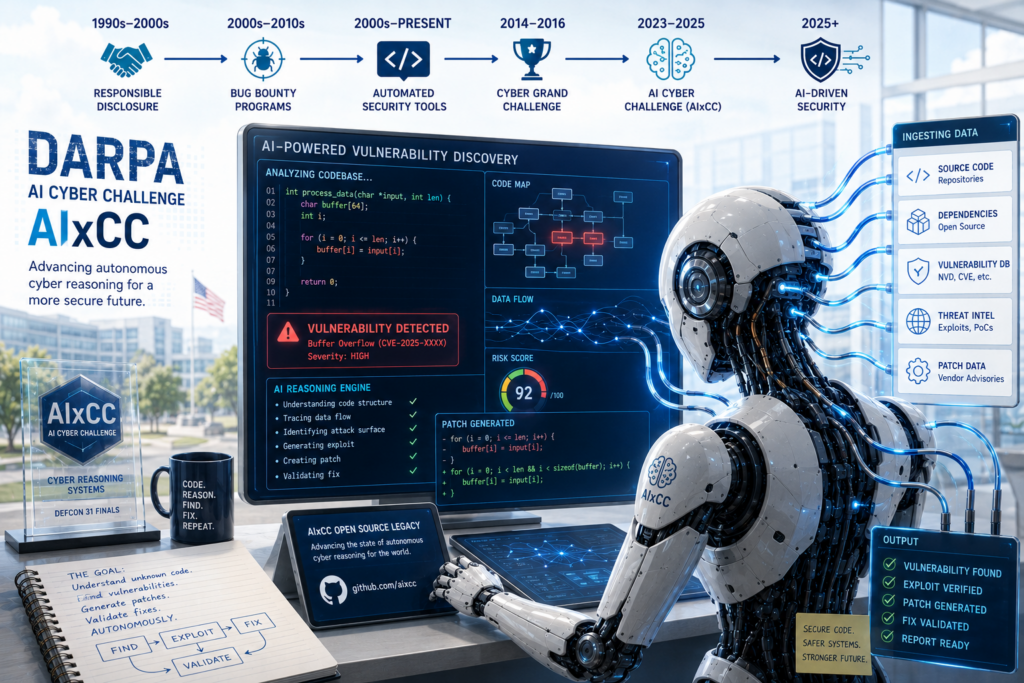
Software vulnerabilities have existed for as long as software itself. Every application contains bugs. Some are harmless. Others become security vulnerabilities that attackers can exploit to gain access, steal data, or disrupt operations. The challenge has never been finding a single vulnerability. The challenge has always been finding the thousands that remain undiscovered.
For decades, vulnerability discovery was largely a human endeavor. Developers wrote code. Security researchers reviewed it. Penetration testers searched for weaknesses. Attackers looked for opportunities. Vendors developed patches, and customers raced to deploy them before those vulnerabilities could be weaponized. Despite tremendous advances in secure software development, software security often felt like an endless game of human-operated whack-a-mole. Finding one vulnerability usually meant there were many more waiting to be discovered.
The past few years have fundamentally changed that equation.
A Brief History
The evolution of software vulnerability discovery has been gradual, with each generation building on the last.
- 1990s-2000s – Responsible vulnerability disclosure becomes more common as researchers begin working directly with vendors before vulnerabilities are publicly released.
- 2000s-2010s – Bug bounty programs emerge, rewarding researchers for responsibly reporting vulnerabilities instead of selling or withholding them.
- 2000s-Present – Static analysis, dynamic analysis, fuzzing, and automated testing become standard components of secure software development.
- 2014-2016 – DARPA launches the Cyber Grand Challenge, demonstrating that autonomous systems can discover vulnerabilities and generate patches without human intervention.
- 2022 – ChatGPT introduces modern generative AI to the public, dramatically increasing interest in AI-assisted software development.
- 2023-2025 – DARPA’s AI Cyber Challenge (AIxCC) revisits autonomous vulnerability discovery using modern AI reasoning.
- 2025-2026 – Commercial AI-driven software security platforms begin emerging from Microsoft, Anthropic, AWS, Google, OpenAI, and others.
Each milestone solved part of the problem. None fundamentally changed the economics of vulnerability discovery until AI.
The Human Era
Finding vulnerabilities has traditionally been expensive because it depends on human expertise.
Organizations developed secure coding standards. Security teams performed code reviews. Red teams attempted to exploit applications before attackers could. Researchers invested thousands of hours studying operating systems, protocols, compilers, and software frameworks in hopes of discovering vulnerabilities that nobody else had found.
Some of those discoveries were responsibly reported to vendors. Others became bug bounty submissions. Others entered a much less transparent marketplace where zero-day vulnerabilities could be bought, sold, or retained by organizations ranging from cybersecurity companies to intelligence agencies to criminal organizations.
Finding a vulnerability, however, is only the beginning.
Someone has to understand it, develop a patch, test that patch, release it, and then convince customers to install it. Even organizations with mature patch management programs rarely achieve perfect coverage. Every missed system becomes another opportunity for an attacker.
Open-source software complicates the picture even further. Modern applications often consist of thousands of components developed by hundreds of independent projects. A vulnerability discovered in a single dependency can affect thousands of commercial products, each with its own release schedule and patching process.
The challenge isn’t simply discovering vulnerabilities. It’s discovering them early enough that they can be fixed before software reaches production and before attackers have the opportunity to exploit them.
The Turning Point
DARPA recognized this challenge years ago.
Between 2014 and 2016, the Cyber Grand Challenge asked whether autonomous systems could discover vulnerabilities, generate exploits, and patch software without human intervention. The winning system, Mayhem, proved that autonomous cyber reasoning was technically possible, but the technology of the day wasn’t yet practical for widespread commercial adoption.
Nearly a decade later, AI had changed dramatically.
When DARPA announced the AI Cyber Challenge (AIxCC) at DEFCON in 2023, the goal wasn’t simply to build a better vulnerability scanner. Teams were challenged to develop autonomous Cyber Reasoning Systems capable of understanding unfamiliar software, identifying vulnerabilities, generating candidate patches, validating those fixes, and doing so with minimal human intervention.
I followed the competition from its public announcement through the finals at DEFCON. At the time, I was fascinated by the concept, although I didn’t fully appreciate how quickly AI would evolve over the next two years. Looking back, AIxCC feels less like a standalone competition and more like a bridge between decades of cybersecurity research and today’s emerging generation of AI-driven software security platforms.
One of the most interesting aspects of AIxCC is that the competing Cyber Reasoning Systems were ultimately released as open source. Rather than producing a single commercial winner, DARPA helped accelerate an entire ecosystem of research that is now influencing both academia and industry.
From Research to Commercial Products
What happened after AIxCC has been just as interesting as the competition itself.
Over roughly the past year, the cybersecurity industry has moved rapidly from research projects to enterprise products. Anthropic drew significant attention with Mythos, demonstrating autonomous vulnerability discovery capabilities that were available only to a limited number of organizations. Although security researchers had already shown that frontier AI models, and in some cases even smaller models, were capable of identifying vulnerabilities and generating exploits, Mythos packaged those capabilities into a cohesive enterprise workflow. That announcement helped convince many organizations that autonomous software security was no longer theoretical.
The response from the industry was immediate. OpenAI announced similar research and capabilities. Microsoft unveiled MDASH. AWS introduced Continuum. Google, Sakana, and other organizations highlighted their own work in AI-driven vulnerability discovery and software security. While the implementations differ, they all point toward the same destination: autonomous systems that can reason about software, identify vulnerabilities, validate findings, and recommend or generate remediations before software reaches production.
The implications extend well beyond software developers. Organizations building software can identify vulnerabilities before release. Organizations purchasing commercial software may eventually be able to independently evaluate the security of that software before deployment or even during procurement, creating new expectations for software vendors and potentially changing how software security is validated and negotiated.
These developments have also attracted increasing attention from governments. As AI systems become capable of discovering and exploiting software vulnerabilities at unprecedented speed, governments have begun examining the potential national security implications of releasing the most capable models and research. Some frontier AI capabilities have reportedly been delayed, restricted, or subjected to additional review because of concerns that the same technologies capable of improving software security could also be misused to accelerate offensive cyber operations. The policy landscape is evolving rapidly and is likely to become as important as the technology itself.
What Changes Next?
The implications extend far beyond writing more secure code.
Historically, software security has been a race between defenders trying to find vulnerabilities and attackers trying to exploit them first. The scarcity of highly skilled vulnerability researchers helped define everything from bug bounty programs to zero-day markets.
AI changes that equation.
If autonomous systems can continuously review software, identify vulnerabilities, generate candidate fixes, and validate those fixes before software is released, the value of undiscovered vulnerabilities begins to shift. The race becomes less about discovering vulnerabilities and more about who can remediate them first.
That won’t eliminate software vulnerabilities. Nor will it eliminate attackers. Every advance in defensive technology eventually inspires new offensive techniques.
Instead, I think we’re witnessing the beginning of another transition in cybersecurity.
Just as static analysis became a standard part of software development, autonomous AI-driven vulnerability discovery is likely to become another expected step in the software development lifecycle. Organizations that build software will increasingly use AI to review their own code before release. Organizations that consume software will increasingly use AI to evaluate what they’re about to deploy, whether that software was developed internally, purchased from a vendor, or assembled from open-source components.
Looking back, AIxCC may not be remembered for crowning a winning team. It may instead be remembered as one of the first public demonstrations that autonomous software security had become practical.
The products emerging today aren’t the destination. They’re the beginning of a new era where AI becomes an active participant in discovering, validating, and remediating software vulnerabilities long before attackers have the opportunity to exploit them.