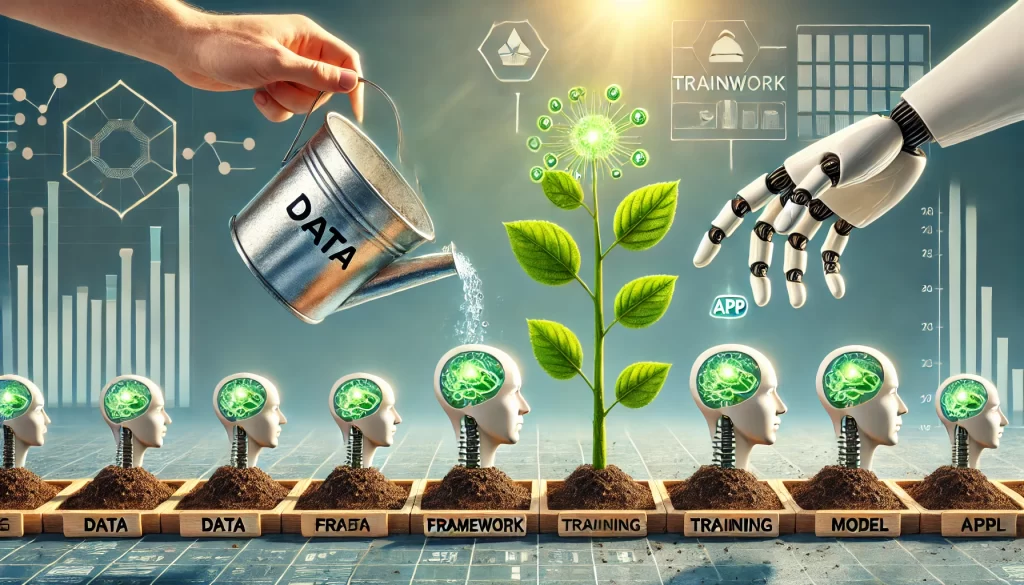
Artificial intelligence is often said to be grown, not built. The phrase, often attributed to thinkers in AI safety circles, captures the idea that modern AI systems are not engineered like traditional software. They are cultivated through data and experience, shaped by feedback, and refined through countless iterations until patterns begin to emerge.
AI did not appear overnight. It grew from decades of progress in computer science, data analysis, and mathematics. The first digital computers in the 1940s and 1950s were designed to solve complex calculations at high speed. By the 1960s, researchers began to wonder if machines could learn from examples instead of being programmed to follow fixed rules. That question led to the earliest experiments in what became known as machine learning.
From Data to Discovery
Machine learning is about recognizing patterns and making predictions from data. It is not so different from how a child learns. A child is shown many objects that are labeled and encouraged to identify them correctly. Over time, the child starts to recognize those same objects in new situations and can even draw similar ones on paper. Machine learning works in much the same way. When a model is shown enough labeled examples, it begins to detect the underlying structure of the data and uses that understanding to recognize or create new content.
For instance, after studying millions of images, a model learns the visual features that distinguish a cat from other animals. Once trained, it can recognize cats in new photos and even generate realistic cat images that never existed before. Language models work similarly by analyzing vast amounts of written text. They learn how words fit together, how sentences form meaning, and how ideas flow in context. That knowledge allows them to write sentences that sound natural and respond intelligently to questions.
How Frameworks Are Developed
As machine learning matured, developers realized that training a model required a huge amount of repetitive and complex work. Every project needed code to handle data movement, mathematical operations, and optimization steps. To make that easier, researchers began building frameworks, which are libraries of reusable modules and functions that handle much of this complexity.
Frameworks such as TensorFlow, PyTorch, and JAX provide the essential building blocks for managing datasets, defining model layers, training, and evaluation. They coordinate the heavy computation required to process large amounts of data efficiently and allow experiments to be scaled from a single computer to large distributed systems.
Different frameworks tend to be used for different learning types.
- Scikit-learn is popular for classical supervised and unsupervised learning methods such as regression, clustering, and decision trees.
- PyTorch, TensorFlow, and Keras are widely used for deep learning, including convolutional and transformer networks.
- OpenCV and Detectron2 specialize in image and vision processing.
- Hugging Face Transformers provides tools for natural language models and text-based applications.
Most of these frameworks are open source, meaning anyone can use or modify them freely. This openness has been central to the rapid growth of AI, encouraging collaboration across universities, startups, and large companies. Some organizations maintain proprietary extensions for optimization or integration with cloud services, but the core frameworks used to train and run models are public.
TensorFlow was developed by Google, building on earlier internal systems. PyTorch emerged from Meta’s research division and quickly became popular for its simplicity and strong integration with Python. Over time, both expanded into complete ecosystems with visualization tools, deployment pipelines, and community libraries that support nearly every area of AI research and development.
How Machines Learn
Frameworks provide the tools, but the way a model learns depends on the training approach. Machine learning techniques are grouped by how they use data to improve over time.
- Supervised learning uses labeled data where the correct answer is known. The model compares its predictions to those labels and adjusts itself to reduce errors.
- Unsupervised learning looks for hidden patterns or groupings in unlabeled data, such as clustering similar items.
- Reinforcement learning teaches through feedback, rewarding correct decisions and discouraging mistakes until the model learns a strategy that produces consistent results.
These methods can be used within any framework and are often combined. For example, reinforcement learning may follow a supervised phase, helping refine a model’s behavior once it already understands basic relationships in the data.
How Pre-Trained Models Are Developed
Frameworks are the tools used to train a model, and once training is complete, every model is effectively pre-trained on the data that shaped it. A model can be thought of as a service that receives an input such as a prompt, file, or query and produces a response based on the knowledge it learned during training. Its understanding is fixed to that knowledge until it is updated or retrained.
You might think of a model as a digital expert that has specific training. That training can be very granular like a book on the 1930’s or can be very general like an encyclopedia.
A pre-trained model begins with a goal, which defines what it should learn, such as understanding language, identifying objects, or analyzing sounds. That goal is implemented within a framework and trained on a dataset that represents the target domain. The training process exposes the model to millions or billions of examples until it forms an internal understanding of patterns that align with its goal.
Note that models can be trained on very small datasets. This is often the case in academic environments or for evaluation or demonstration. Though we tend to rely more on models trained on massive datasets.
Developing such a model follows the same process whether on a laptop or a supercomputer, but training the large-scale models used for public applications requires massive computing power, extensive data preparation, and repeated testing. Once training stabilizes, the model is saved as a versioned checkpoint that others can reuse, refine, or fine-tune for specific purposes.
Platforms such as Hugging Face, TensorFlow Hub, and Model Zoo host millions of publicly available models. Anyone can upload their work, from large research teams to students completing a project. As a result, many of these models are experimental, redundant, or untested. A smaller subset has been validated and widely adopted, often identified by verification badges, popularity scores, or download counts.
Pre-trained models have transformed the field by making advanced AI accessible to anyone. Instead of beginning from zero, developers can now start with a framework or model that already understands language, vision, or sound and adapt it to their specific purpose. This reuse of collective progress is one of the defining traits of modern AI development.
The Role of Data
Much of the data that fueled early foundation models came from publicly available online sources, books, code repositories, and digital archives. The legality and ethics of this collection are still debated. Some early developers scraped massive portions of the internet without clear consent, a practice that allowed them to move fast but would have been difficult for established companies to justify. That early advantage helped a few organizations gain significant momentum.
As awareness and regulation have increased, new entrants face tighter rules on how data can be gathered and used. Larger technology companies also benefit from existing user ecosystems that generate new content every day, which can later serve as training material. Social media, search, and productivity platforms are particularly well positioned because they naturally collect diverse and continuous data streams. Larger companies are also better positioned to deal with the legal risk of the seemly inevitable copyright and privacy lawsuits.
Why Some Train Their Own Models
Training a model from scratch can be costly and technically demanding, but there are several reasons why individuals or organizations might choose to do it. Some pursue this path to meet unique goals, such as analyzing classified information, processing medical imagery, or conducting scientific research where public models are not suitable. Others do it for creative exploration or to gain independence from commercial systems.
It is also true that some attempt to train or modify models to operate outside established boundaries. This includes uses such as generating harmful content, assisting in malicious code creation, or producing explicit or copyrighted material. These practices raise serious ethical and legal issues and are part of why large providers attempt strong controls on model behavior.
Commercial models like ChatGPT are proprietary and cannot be directly fine-tuned by external users. Developers can influence behavior through system prompts or by grounding the model with additional data using RAG, but fine-tuning is limited to the organization that operates the model.
In contrast, millions of open-source models are available through platforms such as Hugging Face, TensorFlow Hub, and Model Zoo. Some are general-purpose, while others are tailored for specific uses like speech recognition or cybersecurity analysis. Open models can often be retrained, adapted, or combined with new data. They offer flexibility and lower cost but may lack the refinement or safety mechanisms found in proprietary systems.
Developers can also build their own models using frameworks like TensorFlow or PyTorch. They can also create code and functions to augment these frameworks. This provides full control but requires deep technical knowledge, powerful computing hardware, and access to quality datasets. It is the most flexible approach but also the most resource-intensive.
How Enterprise AI Systems Operate
It is common to think of systems like ChatGPT or Gemini as single, unified models, but they are actually complex architectures made up of many layers. At their core sits a model or a collection of models trained on vast datasets. Around these are layers of guardrails, prompt filtering, and context routing that determine how a request is processed and which model is used to generate a response.
Incoming prompts may be analyzed and routed to specialized models based on content or intent. Responses can then pass through safety filters and evaluation systems before being returned to the user. Surrounding these layers are features for memory and history management, data collection, telemetry, auditing, and compliance. This orchestration is what turns a powerful but general model into a safe, reliable enterprise service.
So much of what we think of as AI is the development that encompasses these models to make them accessible, richer, and safer to use.
The New Layer: AI Platforms
Many developers now use cloud-based AI platforms such as Azure AI Foundry, Google Vertex AI, or AWS Bedrock to build intelligent systems. These platforms provide access to pre-trained models, scalable computing power, and orchestration tools for building chatbots, copilots, and autonomous agents. They do not replace frameworks but make it easier to assemble complete AI applications without managing the training infrastructure directly.
You could think of frameworks as the Lego factory that produces the individual Lego pieces. The data is the molten plastic poured into molds to form those pieces. The training process acts as the mold, shaping how those raw materials become usable components.
The model is the boxed Lego set, containing a specific collection of pieces and a set of instructions that define what can be built. Developers can use that set as-is, or augment it by adding extra pieces or following alternative instructions, similar to fine-tuning or retrieval-augmented generation (RAG).
A cloud-based AI platform is like a digital Lego workshop, where you can mix pieces from many different sets, build virtually, and share your creations online. It lets you use models and frameworks together to create entirely new applications that can be interacted with through a website or app.
The ChatGPT, Gemini, and Grok Models
The most visible examples of modern AI are ChatGPT, Gemini, and Grok. Each was created with the same basic ingredients: a clear goal, a training framework, and enormous amounts of data.
ChatGPT, developed by OpenAI using the PyTorch framework, was trained on large collections of text from books, articles, websites, and code. It uses a transformer architecture and learns through a combination of supervised learning and reinforcement learning from human feedback, allowing it to respond naturally and adapt to context.
Gemini, developed by Google’s DeepMind and Research teams, was trained using TensorFlow and JAX. It follows similar design principles but was built for multimodal learning, combining text, images, and code. Gemini’s training included web data, licensed sources, and synthetic examples that help it reason across multiple forms of information.
Grok, created by xAI, was also built on a transformer-based framework. Its data included publicly available information and content from the X platform, which allows it to blend conversational tone with current social and cultural topics.
All three models were trained across distributed computing systems containing thousands of processors and refined over many rounds to improve reasoning and reduce bias. Their creation reflects the same process described throughout this article: frameworks provide the structure, data supplies the knowledge, and learning methods transform that information into intelligence.
In Summary
The story of how AI is made begins with decades of progress in computing and mathematics. Frameworks such as TensorFlow and PyTorch gave developers the tools to build and train models efficiently. Machine learning methods define how those tools are applied, from supervised and unsupervised learning to reinforcement systems that learn from feedback. Pre-trained models then built on those foundations, allowing developers to start with systems that already understand language, vision, or sound.
Every model, large or small, reflects the data and goals that shaped it. Proprietary systems like ChatGPT and Gemini showcase what massive investment and computing power can achieve, while open-source communities provide flexibility and experimentation for anyone willing to learn. Developers today can choose to use, adapt, or train models depending on their needs, resources, and values.
AI is no longer the product of a single organization. It is a shared ecosystem of frameworks, models, and platforms that continues to evolve through collaboration and curiosity. Each generation of innovation brings us closer to understanding not just how to make intelligent systems, but how to guide them responsibly.