Before I joined Microsoft, I was able to attend a big Microsoft conference about every other year. I looked forward to those trips and always enjoyed them. Then I joined Microsoft and learned that employees generally are not provided the opportunity to attend these types of conferences. A relatively small group goes to speak or support these events like Ignite, Build, or even RSA. The rest of us watch from home. Every year I look for a speaking slot or a volunteer opportunity that might get me on the schedule and get the company to cover the trip.
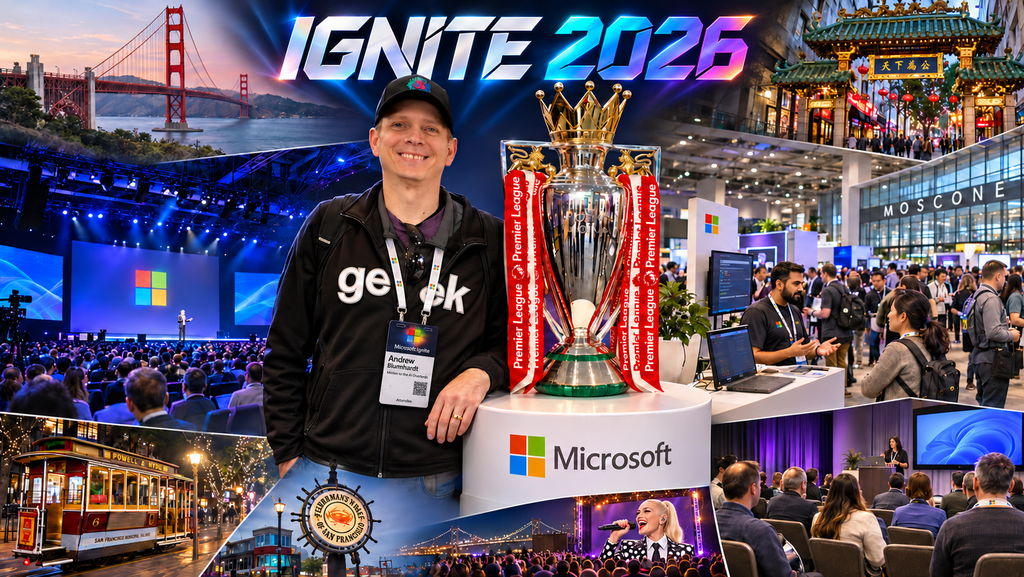
This year, with my ten-year anniversary coming up, I paid my own way. I figured ten years was a good excuse to treat myself, and I wanted to experience Ignite the way a customer would. It was also my first trip to San Francisco, which made it easier to justify spending the money. I had a list of things I wanted to see and photograph, and I could do some of that once the conference wrapped up. Call it an education vacation. I did catch up on work from the hotel, so I suppose workcation applies too.
You might assume I already knew what Microsoft was going to announce. I knew some of it. But I work in security, and one of the things I liked about Ignite was how much of the conference fell outside my day job. At Black Hat, the sessions, the vendor floor, and most of the conversations are about cybersecurity. At Ignite, I could spend part of the day talking about security and then wander into a discussion about geospatial data or how to modernize an old application. Even in the areas I follow closely, a few things were held for Ignite.
There’s a lot to take in at a conference like this. There are the keynotes and sessions, the vendor floor, the swag, and the sheer spectacle of putting on an event that size. The venue, the city, the food, and whatever you get up to after the sessions are all part of the trip too. My favorite part is meeting people. I aim for four or five solid connections a day. That sounds modest until you try it. I mean four or five people I’ve talked with long enough to get to know a little and exchanged contact information with outside of a sales conversation.
Would I pay to do this every year? Probably not. A conference of this size in San Francisco is expensive. Every few years, though, I can see the value. I’ve had enough conversations that started on a bus, in a line, or with the person next to me in a session and turned into something years later. You have no idea which ones will go anywhere at the time. That’s a big part of why I wanted to be there.
The technology I came home thinking about
Microsoft Perception got the most attention in the security sessions I followed. It’s now generally available and brings together security agents and playbooks for investigation and exposure reduction. Codename MDASH was part of the week too, though it got less attention from where I sat. It’s in preview and focuses on finding and validating vulnerabilities in code. I plan to release some blog posts on both of these topics in the coming weeks.
Sentinel, ISOC, and the Data Lake are probably what I’ll write about later this week. Eligible existing Sentinel customers can now opt in to the Integrated Security Operations Center in Defender. Core ISOC capabilities are generally available, while the expanded SIEM experience and 90 days of included retention for eligible Defender data are in preview. The opt-in includes a built-in data lake, and there’s a new preview for monitoring connector health and ingestion across the Analytics and Data Lake tiers. The question I want to answer is what changes for a team already running Sentinel. Where does the data go, how long can I query it, and what will I pay to ingest and retain it?
A few other announcements I’d keep an eye on:
- Vulnerability shielding and threat intelligence. Defender’s shielding preview is aimed at the gap between finding a vulnerability and deploying the patch. Anyone who’s waited for a maintenance window knows how long that gap can feel. I’m also interested in the new prioritization and notifications for emerging threats, and in the security work Microsoft is still doing for supported on-premises Exchange, SharePoint, and Skype for Business servers.
- Local agent security. Entra Agent ID, Intune’s agent discovery and governance, Defender’s runtime controls, and Purview’s data protections each cover a part of the problem. I want to follow one agent running on a managed laptop and see what I can learn about its identity, the data it touched, and what happened when a policy intervened.
- MCP and agent access. The Global Secure Access MCP Firewall is about controlling access to MCP servers and what they expose. The Microsoft MCP Server for Enterprise is a separate item that gives agents permission-based access to Entra data. I want to see what each exposes or controls, what gets logged, and how the newer Entra access-package options handle granting and removing agent access.
I also came home with a longer list of things to dig into. Some were announcements and some were questions I brought with me:
- Machine management, hotpatching, and recovery. I want to see how much administrators can manage from one place, from enforcing secure configurations to spotting drift and tracking which machines need maintenance. With Windows Server 2016 nearing end of support, I also want to compare migration and Extended Security Updates, and look at what recovery actually takes for identity, cloud workloads, and infrastructure if the backups themselves have been compromised.
- Entra across tenants and clouds. Cross-tenant configuration management caught my eye because I’ve worked with organizations that have to keep identity settings consistent across a lot of tenants. I also want to write up a question I keep hearing about Microsoft 365 GCC and how its cloud boundaries relate to Entra and Azure Government.
- Foundry AI Gateway, API Management, and AI Flex. I want to see where Foundry AI Gateway fits when a team already uses API Management. On the cost side, I’d like to take a real mix of usage across Foundry, Copilot, GitHub Copilot, and Security Copilot and see when a shared commitment makes sense.
- GitHub Advanced Security AI Scan and Azure Catalyst. I’d like to run AI Scan alongside CodeQL and see what each finds and what makes it into a pull request. Azure Catalyst caught my eye for a different reason. I want to see how far it can take an application modernization project, from deciding what to change through the changes to the code.
- Microsoft Planetary Computer and Fabric Maps. After spending part of this year building a threat atlas with Azure Maps, I’d like to take a real geospatial dataset and see what it takes to find it, analyze it, and put the result on a map someone else can use.
A few more Ignite announcements worth a look
- Microsoft IQ. Microsoft brought Work IQ, Fabric IQ, Foundry IQ, and Web IQ together under a generally available platform for giving apps and agents access to the context they need. If you’re building agents, it’s worth seeing what each of those can contribute and how teams can reuse skills and tools across applications.
- Agent 365 Business Analytics. This Frontier preview brings spending and outcomes for Microsoft and third-party agents into the same reporting experience. With more teams deploying agents, I’m interested in whether that gives them enough information to decide which ones are worth keeping.
- Rayfin and Fabric apps. Both reached general availability. If your team already does its analytics in Fabric, the part worth looking at is how you can build an application around that data with hosting, authentication, and backend services already available.
What it was like to be there
My 5 a.m. flight out of Bloomington was canceled, so I drove to O’Hare and flew out of Chicago. I made it to San Francisco on Monday afternoon, registered, and got my bearings around Moscone. I had enough time to walk through Dragon’s Gate, visit the Nintendo store, and find dinner. I went to bed thinking I had a pretty good sense of where I needed to be the next morning.
I showed up early Tuesday to get a good seat for the keynote. I’d shown up early at the conference center. The keynote was at Chase Center. Forty-five minutes of shuttle traffic later, I’d missed the first 20 or 30 minutes, but I’d had a good conversation with the person next to me and still caught the gist. I beat the exit crowd, rented a scooter, and spent about 20 minutes riding back through downtown. That was a much better way to see the city.
Back at Moscone, I got in line for conference merch, stopped at the store, caught a few sessions, and spent the better part of the day talking to vendors. I struck out on finding an evening event or arranging a meetup, so I went for sushi and headed back to the hotel to catch up on work.
Wednesday’s storms temporarily flooded part of the exhibit area and closed the vendor floor. I spent most of the day in sessions and met a few people over lunch at the KPMG AI House. That evening I was back at Chase Center for Gwen Stefani. On the bus there, I wondered if I could name two of her songs. Once she started singing, I knew nearly every one. Apparently I’d been hanging on to those lyrics since the No Doubt years.
The vendor floor reopened Thursday and stayed open late. I split my time between sessions and the floor and stayed until about 6:30. One of my favorite conversations that week was with someone who used to work on Azure Maps and had since joined a geospatial startup. As soon as I mentioned the threat atlas, we had plenty to talk about.
Later Thursday, I went to what I thought was an n8n vendor party I’d found through ChatGPT. I knew a little about n8n because some of my customers use it to build agents, and when I walked in and saw several people wearing Ignite badges, I figured I was in the right place. They turned out to be n8n representatives who’d stopped by to say a few words before heading to the airport. Once they left, I looked around and realized I was the only Ignite attendee in a room of about 25 to 30 people. I’d walked into a local n8n user group.
I stayed for the presentation and had a few interesting conversations afterward, over cold pizza and soft drinks. The pizza was pretty good. It was one of several times on the trip that using ChatGPT to make plans landed me somewhere I wouldn’t have picked on my own. If I’d known exactly what it was, I probably would have spent the evening doing something else. I’m glad I stayed.
Friday had three session slots before things wrapped up around noon. By then I’d had about 20 conversations where I felt I’d gotten to know somebody a little, even though I’d missed several people I already knew were there. Next time I’ll put a couple of dinners on the calendar before I leave. I’m glad I had time to wander the floor and talk to whoever I happened to meet, too.
The vacation part
By Friday afternoon I was fighting a cold, so I went back to the hotel to rest before heading to Stonestown Galleria for ramen, arcade games, and a Hunger Games movie in 4DX. At first I thought the seats could throw me around a little more. By the end, I was grateful they hadn’t.
I slept in Saturday, took a Waymo to the Golden Gate Bridge, and walked along the waterfront through Crissy Field, past the Palace of Fine Arts, and over to the Letterman Digital Arts Center in the Presidio. That’s where the Lucasfilm offices and the Yoda Fountain are. I was pleasantly surprised to find the store open. Another Waymo took me to Fisherman’s Wharf for old arcade machines at Musée Mécanique, some window shopping, and dinner. I spent a fair amount of both rides watching how the car drove. It pulled over for an emergency vehicle and stopped for pedestrians standing between two parked cars. By the second ride, I was already getting used to the empty driver’s seat.
After some window shopping and gelato in Japantown, I ended Saturday at Audium for Merlin Coleman’s Explorations of Extraction and Decay. A dozen of us sat in folding chairs in the dark while voices, music, and field recordings from a quarry and a landfill moved around the room through 176 speakers. It felt very Californian and artsy, and a little outside my comfort zone. I loved hearing the sound move around the room. I was less sold on the show’s take on extraction and waste, especially sitting in the middle of a city that depends on both.
Sunday was an early flight, an uneventful drive from Chicago, and the obligatory stop at Wally’s, our regional answer to Buc-ee’s. I was home by about 5:30 Central. I’ve already got people to follow up with and a few things I want to test. First, though, I’m going to unpack and get rid of this cold.