For the past few years, shortly before the beginning of the school year, I have required my two children to attend what I call “Andrew University.”
It is only an hour. We sit down as a family and talk about school, grades, priorities, technology, and some of the lessons I have learned from my own education, career, mentors, mistakes, and my own father. Both of my children are now in college. One is beginning senior year and living in the dorms, while the other lives at home and attends community college.
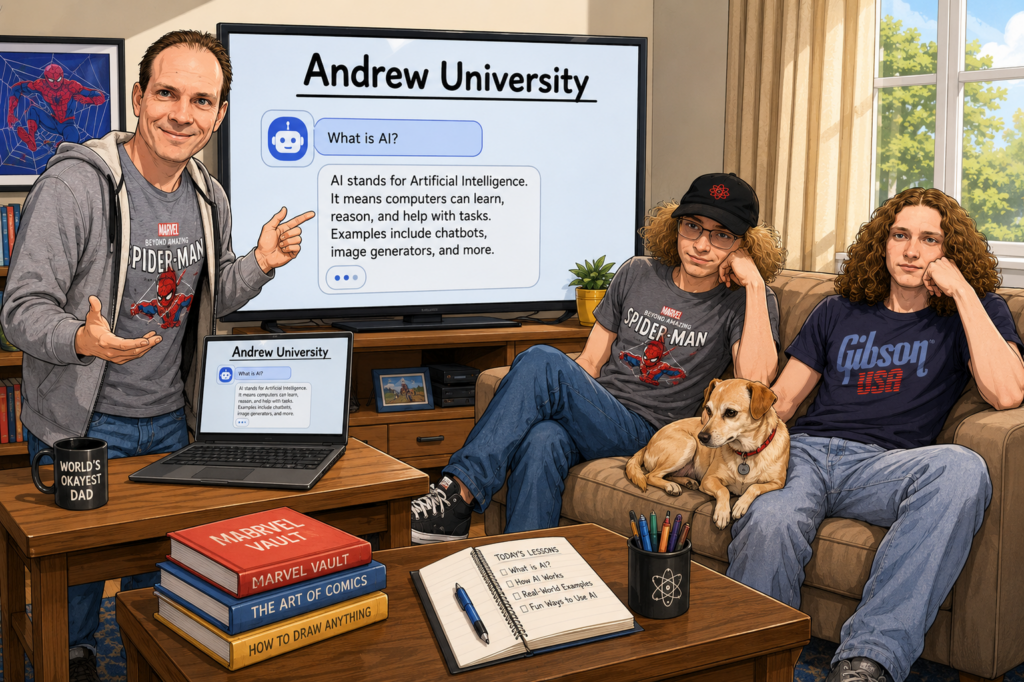
I do not place many mandatory requirements on them anymore. They are adults and increasingly responsible for their own decisions. However, one hour of Andrew University before the semester begins remains mandatory. Family vacations are also mandatory, at least while I am paying the bills. That seems like a small price to pay for college tuition and the occasional contribution to their pockets.
We recently held this year’s session, and I thought some of the advice we discussed might be worth sharing. In fact, this article was originally dictated to an LLM while I was walking my dog, which illustrates one of the lessons I am trying to teach them.
You Begin Every Class With an A
The first point I make is that before the semester begins, they have an A in every class.
Their job is not to earn an A. Their job is to keep it.
Until they miss a question, turn something in late, or submit work that does not meet the requirements, they effectively have 100 percent. Every assignment, quiz, and exam is an opportunity to protect that grade.
I think of it almost like a strategy game. The objective is to make it through the semester without unnecessarily surrendering points. That means understanding the rules, anticipating challenges, meeting deadlines, and making good decisions about where to spend time.
Many students mentally assign themselves a grade before a class even begins. Based on previous experiences, they may think of themselves as a B or C student. They expect a certain level of performance and unconsciously settle into it.
I want my children to begin with a different assumption. The A is not merely something to strive for. The A is the only acceptable destination.
That may sound like the philosophy of an overbearing parent, but the world they are entering is becoming increasingly competitive. AI is changing the workplace, eliminating some tasks, redefining others, and raising expectations for what one person can accomplish. The remaining jobs may require people to demonstrate more capability, adaptability, and initiative than they did in the past.
AI is also changing the academic environment. Many of their classmates are already using it to improve assignments, check their work, study for exams, and sometimes do work they should be doing themselves. Whether every use is permitted or not, AI is raising the average quality of what students submit.
That makes it even more difficult to stand out. A good grade may no longer distinguish someone as much as it once did, but a mediocre grade can still place them behind their peers.
Expecting an A does not mean working yourself to the bone or sacrificing everything else in your life. It means approaching the class strategically and intentionally. Understand exactly what is expected, plan the work, monitor the grade, and use every ethical tool available to produce the required outcome.
A 4.0 may not be enough by itself, but it is still a much better starting point than having to explain why you did not achieve one.
Turn In the Assignment
Learning and earning a grade are closely connected, but they are not always the same thing.
A reasonably good assignment submitted on time might earn a B. That is not the outcome we are aiming for, but it is considerably better than submitting the assignment late and receiving a major penalty or even a zero. Hopefully, the lower grade can be offset by stronger performance elsewhere and the student can still finish the course with an A. A zero is much harder to overcome.
Turning in assignments on time is not optional. It is an absolute necessity.
With proper planning, assignments should not merely be submitted moments before the deadline. They should be completed well in advance whenever possible. Many courses make assignments available days or weeks before they are due. Working ahead creates breathing room and helps prevent several major assignments from colliding later in the semester.
It also provides time to review the work, compare it with the rubric, ask questions, and correct anything that was overlooked. If an unexpected problem arises, the assignment is already finished or close to it.
However, when the deadline is approaching, submit the best work you have. A reasonably good assignment submitted on time is considerably better than an excellent assignment submitted too late to receive credit.
There is almost always something that could still be improved, but at some point, the student has to deliver.
That is also an important professional lesson. Deadlines matter. Commitments matter. Other people need to be able to depend on you.
The objective is not to choose grades instead of learning. It is to avoid losing the grade through preventable mistakes. Learn as much as possible, but also understand how the class works and complete what is required.
Use Speech-to-Text to Capture Your Thoughts
One of the technologies I demonstrated during Andrew University was AI-assisted speech-to-text dictation.
Most people speak more quickly than they type, even if they are reasonably fast typists. Speaking also removes some of the mechanical distraction of typing and can make it easier to become lost in thought.
A student can talk through the structure of a paper, organize notes, plan an assignment, create a journal entry, or compose a group message. Dictation can capture that stream of thought and turn it into text that can be refined later.
It can also make otherwise unused time productive. A student might think through an assignment while walking, exercising, driving, or sitting in a waiting room, assuming it is safe and appropriate to do so.
This does not have to mean asking AI to write the paper. It can simply provide a faster path from thought to text. The ideas still belong to the student. The technology reduces the friction involved in capturing them.
Use LLMs to Strengthen Your Work
Large language models offer a much broader set of capabilities.
Both of my children have shown an unusual reluctance to embrace AI as part of school. In some ways, I respect that. They seem to believe that school should be completed the hard way and that using AI somehow diminishes the accomplishment.
However, refusing to use AI is beginning to feel a little like taking a mathematics course and refusing to use a calculator.
Working without a calculator can help someone understand the fundamentals. There are times when students should solve a problem themselves. But even if they do all the work manually, why would they refuse to use a calculator to check the answer before turning it in?
AI can serve a similar role. It does not have to replace the work. It can help students understand, organize, check, and improve the work.
If an instructor provides an assignment description and grading rubric, a student can give those materials to an LLM along with the completed assignment. The model can identify overlooked requirements, unclear explanations, potential errors, and areas that could be strengthened before submission.
An LLM can also help explain difficult material. A student can capture a screenshot from a website or take a photograph of a textbook page or presentation slide and ask questions about it. Instead of remaining stuck on a confusing paragraph or unfamiliar diagram, the student can ask for another explanation, an example, or a simpler description.
The same approach can make large collections of documentation easier to navigate. Reading the source material remains important, particularly when accuracy matters, but an LLM can act as a guide. It can summarize a section, define an unfamiliar term, compare related concepts, or help identify which portions deserve closer attention.
Students can also use an LLM to organize notes, create study questions, build a schedule from several syllabi, check code or formulas, and prepare for a discussion. These tools can reduce the time spent searching through material and increase the time available for understanding it.
Of course, AI makes mistakes. Students need enough knowledge and judgment to recognize questionable information and verify anything important.
There is also an obvious ethical boundary. Every student should understand and follow the school’s academic-integrity policies and the rules established for each class. They should also provide proper attribution when the instructor, school, or nature of the assignment requires it.
Using AI to explain a concept, check original work, or improve a draft is very different from having it secretly complete an exam or produce an assignment the student submits without understanding.
The goal is to use AI to extend your abilities, not replace your education.
Become Proficient, Not Merely Familiar
Using an LLM occasionally is not the same as becoming proficient with one. Students should learn how to ask better questions, provide useful context, recognize hallucinations, verify important claims, and collaborate with the model instead of simply asking it to do the work.
They should also learn how to turn AI assistance into high-quality work rather than generic AI slop. An LLM can help someone write faster, communicate more clearly, and become more articulate through the written word. However, the student remains responsible for shaping the ideas, verifying the information, and making sure the final result sounds like something they would genuinely say.
If the finished work obviously reads like an unedited AI response, the student is not using the technology particularly well.
There is an odd duality emerging in schools and workplaces. Using AI is increasingly expected and, in some organizations, nearly required. At the same time, there can be something disingenuous about making its involvement blatantly obvious.
High-quality work may now be assumed to have benefited from AI, but it should still reflect the knowledge, judgment, voice, and effort of the person submitting it. The same applies to emails, documentation, presentations, homework, and other work products. AI should improve the final result without replacing the person responsible for it.
This principle is particularly important when participating in professional or technical communities. If someone asks a question in a forum, assume they have probably already asked an LLM. They are coming to other people because they want experience, judgment, and real-world perspective.
Copying their question into an LLM and pasting the response verbatim into the discussion is one of the poorest uses of AI. It adds little that the person could not have obtained alone and can feel insulting to everyone involved. The unspoken message is, “You could have looked this up yourself, but you did not, so I asked the AI for you.”
The value you add is not access to the LLM. It is the experience, judgment, and perspective you contribute beyond its answer.
True proficiency means knowing how to use AI without surrendering your own voice or responsibility. It should make you faster and more capable while still leaving something recognizably human in the result.
Learn to Adapt Before Everyone Else Does
The larger lesson is not simply that students should learn how to use today’s AI tools. They need to become comfortable identifying, learning, and maximizing whatever new technologies emerge.
That ability is quickly becoming a major differentiator in the workplace. The advantage does not always go to the person who works the longest or possesses the most traditional expertise. Increasingly, it may go to the person who recognizes a useful new capability, becomes proficient with it, and incorporates it into their work before everyone else catches up.
AI-assisted dictation and LLMs are current examples. A student who becomes proficient with them can accomplish certain tasks faster and more effectively. More importantly, that student is developing the habit of experimentation. They are learning how to evaluate a new technology, understand its limitations, and turn it into a practical advantage.
The specific tools will change. The ability to adapt quickly will remain valuable.
Early adopters have a temporary window in which a new capability can provide a genuine competitive advantage. Eventually, that advantage becomes the new baseline.
Students should become comfortable recognizing those windows and using them before they close.
Learn the System Before the Class Begins
Students should take full advantage of the online tools their schools provide. Platforms such as Canvas can contain the syllabus, course material, assignments, grading rubrics, announcements, calendars, and current grades. When used properly, these systems provide much of the information needed to develop a strategy for succeeding in the class.
Before the first day, a student should understand what the course is supposed to teach, how the grade will be calculated, and which major milestones are ahead. Is there a final exam? A capstone? A group project? Several large papers?
Those dates should be identified early and placed on a calendar. When four or five classes are happening simultaneously, an LLM can even help combine the syllabi into a working semester plan.
Never walk into a classroom completely unaware of what you are there to learn.
Skim the material in advance. Know what topic will be discussed. Know when an assignment is due and whether a quiz is approaching.
Preparation changes the classroom experience. Instead of hearing everything for the first time, the student arrives with some context and can use the class to reinforce and deepen that understanding.
The same habit becomes important in professional life. People should not walk into an important meeting blind. They should understand the subject, know who will be attending, and research the organization or people involved when appropriate. Preparation makes meaningful participation possible.
College is one of the best places to develop that habit.
Your Education Is Your Responsibility
Another lesson I try to reinforce is that the professor is not ultimately responsible for a student’s success.
The professor guides the course, explains the material, establishes expectations, and evaluates the work. The student remains responsible for learning and earning the grade.
Some professors are exceptional. Others are not. A weak instructor can make a class unnecessarily difficult, and inconsistent teaching or grading can create legitimate obstacles.
A bad professor is not an excuse for failing or accepting a lower grade.
Students usually have access to textbooks, course materials, classmates, tutors, office hours, online resources, and AI systems that can explain almost any foundational topic. A difficult professor may change how the student must learn, but it does not eliminate the student’s responsibility to find a path through the class.
That principle carries into professional life. A poor manager, unclear expectations, or a difficult workplace can create real obstacles. We are still responsible for managing our careers, developing our abilities, seeking support, and deciding what to do next.
Assess the Situation and Ask for Help
Taking responsibility also means honestly assessing whether the current plan is working.
Students should not wait until the final weeks of the semester to recognize that they are in trouble. Early in the course, they should ask whether the material is more difficult than expected, whether the workload is manageable, and whether outside responsibilities are interfering with school.
Once the problem becomes visible, they need to act.
That might mean attending office hours, joining a study group, finding a tutor, watching supplemental lessons online, or paying for an additional learning resource. Spending a modest amount on tutoring or a supporting course can be insignificant compared with the cost of failing or repeating a college class.
Students also need to become comfortable asking other people for help. Classmates may be interested in forming a study group. Professors and teaching assistants may be far more helpful than expected. Family members may be willing to contribute toward a tutoring service or another resource if they understand what is needed.
Accepting help is important, but so is giving it.
Some of the most valuable relationships in college and throughout a career begin when people help one another. Explaining a difficult idea to a classmate can strengthen your own understanding. Teaching and mentoring can develop leadership and communication skills while building relationships that may continue long after the class ends.
Develop the habit of asking for help when you need it and offering help when you can.
College and professional life are not purely individual competitions. Most people advance further when they become part of a community that supports one another.
Know When to Leave a Bad Situation
Sometimes additional effort and support will not be enough. A class may be the wrong fit, the schedule may be unworkable, or the student may have taken on more than can reasonably be completed.
Most schools provide a period during which a student can withdraw without receiving a permanent failing grade. That deadline matters.
There is no prize for remaining in an impossible situation until it causes lasting damage. If a student has realistically assessed the course, sought appropriate help, and still cannot see a path to success, withdrawing may be the most responsible decision.
The important thing is to recognize the situation early. Dropping a class should not be the first response to difficulty, but neither should it be viewed as an unacceptable failure.
Sometimes changing the plan is the best way to protect the larger objective.
Build Relationships and Advocate for Yourself
Building a relationship with a professor begins with two simple things: participate and pay attention.
Ask thoughtful questions, attend office hours, and demonstrate that the course matters to you. Do not monopolize the professor’s time or become a nuisance. Simply be present, engaged, and respectful.
In a physical classroom, that can mean sitting where it is easier to remain attentive, looking up from the phone, and providing some nonverbal indication that the lecture is reaching another human being. Teaching an unresponsive room can be demoralizing.
In an online course, engagement may mean contributing thoughtfully to discussions, communicating professionally, attending virtual office hours, and asking good questions.
Professors are human beings. Most try to grade fairly and prevent personal feelings from influencing the outcome, but relationships still matter. When a student is near the border between two grades or needs some reasonable flexibility, it cannot hurt for the professor to know that the student has been engaged, worked hard, and genuinely cares about the outcome.
A relationship with a professor can also lead to far more than a grade. Professors can become mentors, references, professional contacts, and occasionally friends. They may know about internships, research, conferences, and other opportunities that students would otherwise never encounter.
Students should also monitor their grades closely and respectfully advocate for themselves. If they receive a poor grade, they should understand why. That does not mean demanding points they did not earn. It may mean acknowledging the mistake, asking how to improve, and making it clear that the outcome matters.
Passive acceptance can signal that the result did not matter. A respectful conversation establishes that the student cares, wants to improve, and intends to avoid the same outcome in the future.
The same principle applies in a career. Your manager should know your goals, whether you want more responsibility, a promotion, the opportunity to become a manager someday, or access to conferences, travel, and other professional experiences.
It is always a mistake to assume that someone else already understands your goals.
A professor may not automatically know how important earning an A is to you, just as a manager may not know that you want to lead a team or pursue a particular opportunity. Communicate those ambitions clearly.
People are much better able to help you reach your goals when they know what those goals are.
Opportunities Rarely Come Looking for You
College provides opportunities that may never again be available in quite the same way. Students can pursue internships, study abroad, leadership roles, and professional conferences.
But most of those opportunities do not simply appear.
Someone has to notice the announcement, read the email, ask the question, complete the application, write the essay, or submit the request before the deadline. Students must tell professors and advisers that they are interested. They have to put themselves forward, even when they are uncertain whether they will be selected.
Opportunities rarely come looking for you. You have to make it known that you want them.
A 4.0 may not be enough to distinguish someone in a world where AI helps nearly everyone produce better work. Experiences, initiative, relationships, and the willingness to pursue difficult opportunities may become increasingly important.
This is one area where it can be particularly difficult to watch my children hesitate. Sometimes opportunities are missed because of distraction, self-doubt, or a lack of urgency. I would not call it disappointment as much as the frustration of seeing possibilities that they may not yet recognize.
Perhaps that is partly a difference in personality. Some people naturally chase every interesting possibility, while others need more encouragement to put themselves forward. Neither approach is inherently wrong, but opportunities are difficult to recover once the deadline has passed.
College is also a relatively safe time to experiment more broadly. Students can explore different careers, relationships, identities, communities, and ways of living. They can try unfamiliar activities and discover parts of themselves that may not have had room to emerge before.
Some experiments require good judgment and restraint, but experimentation is part of becoming an adult. When better to learn some of those lessons than while young and surrounded by people who are doing the same?
Protect the Experience, Too
Grades matter, but they are not the only thing that matters.
Students need rest, health, friendships, and memorable experiences. Someone fortunate enough to participate in college life should enjoy it. The relationships and social experiences can be as meaningful as anything taught in a classroom.
The point is not to place grades far above everything else. It is to keep them near the front of a group of priorities that all deserve attention. Academic performance may occasionally deserve the deciding vote, but it should not consume the entire experience.
It takes maturity to leave a party early because there is an exam the next morning. It takes discipline to put down the gaming controller, stop scrolling, or turn down another activity because an assignment needs attention. At other times, the right decision may be to close the laptop and spend an evening with friends.
The goal is not to avoid the college experience. It is to make deliberate choices instead of allowing the easiest or most entertaining option to win automatically.
Preparing for an Uncertain World
Underneath this annual conversation is probably some anxiety about the world my children are entering.
AI is changing society and the workplace at a remarkable pace. Political instability, economic uncertainty, and concerns about the direction of social progress add to that uneasiness. None of us knows exactly what opportunities will exist or what skills will be most valuable several years from now.
Some people prepare for uncertainty by building bunkers and accumulating emergency supplies. I suppose I am becoming a kind of professional prepper.
My preparation is to strengthen my education, professional credibility, technical fluency, relationships, and network. I want to become more adaptable and more difficult to overlook. I am trying to pass that same sense of preparedness and competitiveness to my children.
I cannot predict what the workplace will look like when they are fully established in their careers. I can only encourage them to prepare for uncertainty: protect the grades, meet every deadline, learn to use the tools, adapt quickly, build relationships, help others, pursue opportunities, ask for help, and take responsibility for the outcome.
I do not know how much of my annual lecture they absorb. Teaching your children is rarely that simple, especially once they are adults with their own personalities, ambitions, and ideas about what matters.
But if even a little of it sticks, our one hour of Andrew University will have been time well spent.